Quick Overview
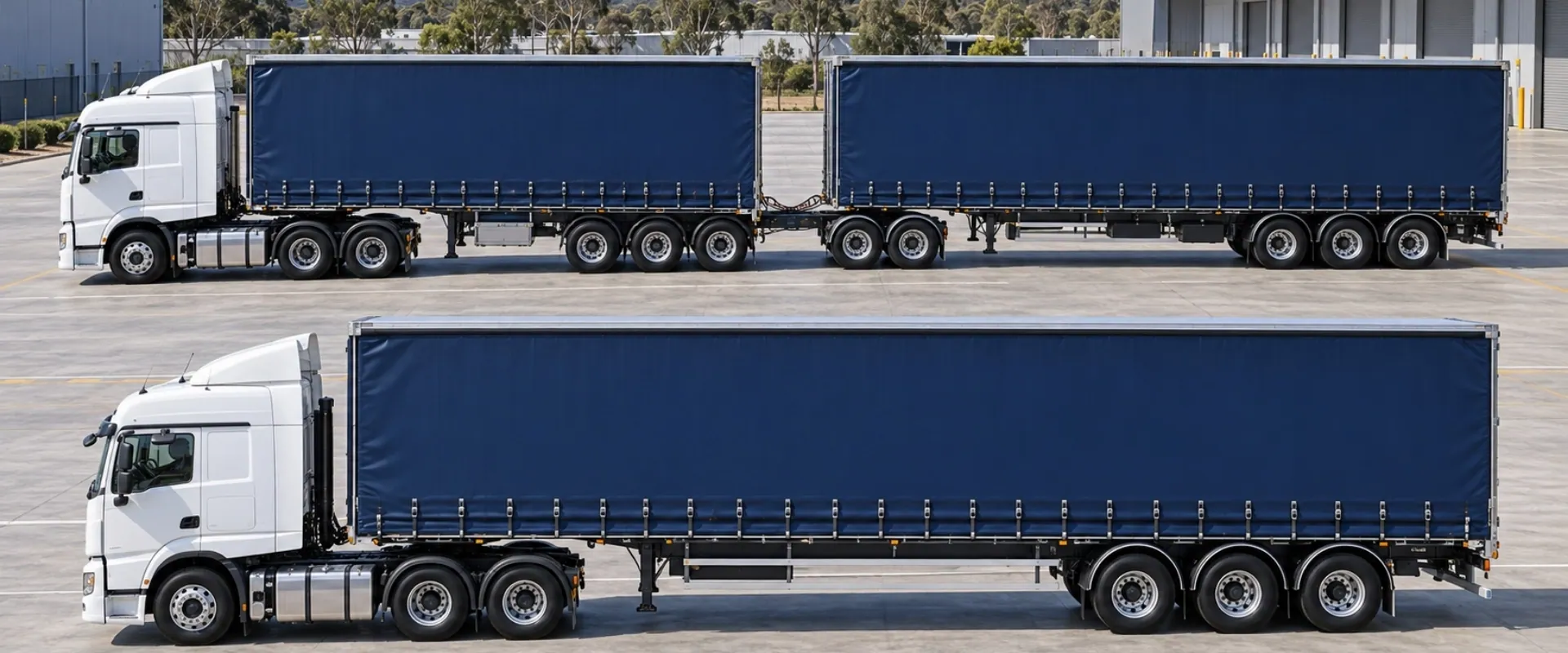
A semi-trailer is a prime mover pulling one trailer, around 19 metres overall, carrying roughly 22 Australian standard pallets and up to about 42.5 tonnes gross. It has general road access, It can go almost anywhere a truck is permitted.
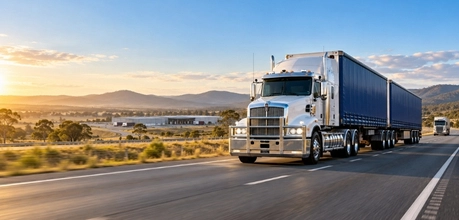
A B double is a prime mover pulling two trailers linked by a fifth wheel on the lead trailer, usually 25 or 26 metres overall, carrying roughly 34 to 40 pallets and up to about 62.5 tonnes gross under general mass limits. It is substantially cheaper per pallet, but it can only travel on approved routes, needs a driver with an MC licence, and cannot get into most metro sites.
The short decision rule: if your freight fits on one trailer, or the destination is a suburban site, take the semi. If you have the volume to fill two trailers and both ends sit on an approved B-double route, the B-double will move it for less.
Introduction
Articulated vehicles carry the overwhelming majority of Australia’s road freight tonne-kilometres despite being a small fraction of the vehicles on the road, according to the ABS Survey of Motor Vehicle Use. Within that category sits a split most freight buyers never think about but pay for on every invoice, whether their goods travel on one trailer or two.
The b double vs semi trailer question looks like a specification comparison. It is really an access question. A B-double moves significantly more freight for not much more cost, which would make it the obvious choice if it could go everywhere. It can not and that single constraint decides most real-world jobs before payload ever enters the conversation.
This guide covers what each configuration is, the legal limits that apply in Australia, five factors worth weighing and how to work out which one your shipment actually needs.
What Is a B-Double Truck?

A B-double is a prime mover pulling two semi-trailers. The lead trailer carries a fifth wheel coupling on its rear, and the second trailer connects to that rather than to a drawbar which is what distinguishes it from a truck and dog or an A-double.
That coupling design matters for stability. Because the second trailer pivots on a fifth wheel directly above the lead trailer’s rear axles, a B-double tracks far better through corners and at speed than a drawbar combination of similar length. It is why B-doubles are permitted on major highways where other multi-combination vehicles are not.
Typical Australian specifications:
- Overall length: commonly 25 or 26 metres, depending on the approved configuration
- Gross combination mass: up to around 62.5 tonnes at General Mass Limits for a nine-axle combination
- Higher Mass Limits: up to around 68 tonnes, subject to accreditation, telematics monitoring and route approval
- Pallet capacity: roughly 34 to 40 Australian standard pallets, or around 60 or more Euro pallets
- Driver licence required: MC (Multi Combination)
- Access: restricted to approved B-double routes only
What Is a Semi-Trailer?
A semi-trailer is a prime mover pulling a single trailer. It is the default articulated vehicle in Australia and the one most freight moves on.
Its defining advantage is access. A semi-trailer operates under general access provisions, which means it can travel on most of the road network without a route permit or a specific notice subject to local restrictions such as load limits, curfews and residential bans.
Typical Australian specifications:
- Overall length: 19 metres under general access
- Gross combination mass: up to around 42.5 tonnes at General Mass Limits for a six-axle combination
- Pallet capacity: roughly 22 Australian standard pallets, or around 34 Euro pallets
- Driver licence required: HC (Heavy Combination)
- Access: general most of the network, including metro areas
B-Double vs Semi-Trailer: Key Differences at a Glance
Here is a practical semi trailer vs b double comparison. Figures are indicative, not a booking guarantee, operators must confirm their actual equipment and operating conditions.
| Factor | Semi-Trailer | B-Double |
|---|---|---|
| Configuration | Prime mover + one trailer | Prime mover + two trailers via fifth wheel |
| Overall length | Around 19 m | Commonly 25-26 m |
| Gross combination mass (GML) | Up to around 42.5 t | Up to around 62.5 t |
| Higher Mass Limits | Limited application | Up to around 68 t with accreditation |
| Payload (indicative) | Around 24-26 t | Around 40-45 t |
| Australian standard pallets | Around 22 | Around 34-40 |
| Euro pallets | Around 34 | Around 60+ |
| Road access | General access — most of the network | Approved B-double routes only |
| Driver licence | HC (Heavy Combination) | MC (Multi Combination) |
| Metro site access | Good, most industrial sites | Limited, needs large yard and approved route |
| Cost per trip | Lower | Higher |
| Cost per pallet | Higher | Lower when filled |
| Manoeuvrability | Good | Requires significant space to turn and reverse |
| Best for | Metro delivery, smaller loads, varied destinations | High-volume interstate line-haul on approved corridors |
B-Double vs Semi-Trailer: 5 Factors to Consider
1. Route access and permits
This is the first question, not the fifth, because it can rule out a B-double entirely regardless of how much freight you have. B-doubles may only travel on roads gazetted as approved B-double routes. Those networks are published by road managers and can be checked through the National Heavy Vehicle Route Planner. Both ends of your journey must sit on an approved route and the last few kilometres into an industrial estate are where approvals most often run out.
A practical consequence worth understanding, many interstate movements run as a B-double on the highway, then the trailers are split at a depot and delivered separately by semi. That is normal and efficient, but it means the B-double saving applies to the line-haul leg, not to the whole door-to-door job.
2. Payload and volume
A B-double carries roughly 1.7 to 1.8 times what a semi-trailer carries. If you can fill it, that is a substantial efficiency gain. If you cannot, you are paying for capacity you are not using and a half-empty B-double costs more than a full semi.
Check which limit you hit first. Dense freight such as tiles, stone, beverages or steel hits the weight limit long before the trailers are full. Light bulky freight fills the space with tonnes to spare. Knowing which applies to your product determines whether the extra trailer actually buys you anything.
3. Cost per tonne and cost per pallet
A B-double costs more per trip, more fuel, higher registration, a more experienced driver, more tires. But it carries far more, so when it runs full the cost per pallet drops well below a semi-trailer’s.
The honest framing compares cost per pallet or per tonne, not cost per trip. A quote that looks more expensive on the surface is usually cheaper per unit once you divide it by what is actually on board. The reverse is also true: a cheap-looking B-double rate on a half load is a poor value.
4. Site access and manoeuvrability
A 26-metre combination needs a genuinely large yard to turn, position and reverse onto a dock. Older industrial estates, inner-suburban warehouses, retail sites and anywhere with tight entry angles frequently cannot take one, even when the road leading there is approved.
Worth confirming before booking: yard dimensions, turning space, dock approach angle, overhead clearance at the gate, and whether the vehicle can exit without reversing onto a public road. A semi-trailer gets into sites a B-double simply cannot, and discovering that on delivery day is expensive.
5. Driver licensing and availability
A semi-trailer requires an HC licence. A B-double requires an MC licence, which sits above HC and requires additional experience and assessment.
MC drivers are a smaller pool than HC drivers and command higher rates, which feeds directly into the cost difference and into availability at short notice. During peak periods the lead-up to Christmas, end of financial year MC capacity tightens before HC capacity does. If your freight is time-critical during a peak, that is a real planning consideration rather than a technicality.
When Should You Choose a B-Double?
Choose a B-double when most of these are true:
- You have enough volume to fill two trailers roughly 34 pallets or more
- Both origin and destination sit on approved B-double routes
- Both sites have the yard space to manoeuvre a 25 to 26 metre combination
- The movement is long-distance interstate freight transport, where line-haul dominates the cost structure
- You are moving between depots or distribution centres rather than to retail or suburban sites
- Cost per tonne matters more to you than delivery flexibility
- Your freight is consistent enough to plan full loads rather than hoping to fill them
When Should You Choose a Semi-Trailer?
Choose a semi-trailer when most of these are true:
- Your load fits on one trailer around 22 pallets or fewer
- The delivery site is metro, suburban, retail or in an older industrial estate
- Any part of the route is not an approved B-double road
- You are doing multiple drops rather than a single point-to-point movement
- Yard space at either end is tight
- You need flexibility at short notice, where HC driver availability is better
How to Choose the Right Truck for Your Shipment
Before requesting a rate, prepare the following information. It helps the transport provider recommend a vehicle rather than guess from the number of pallets.
- Freight details: item type, number of pallets, each pallet’s length, width, height and gross weight.
- Handling needs: stackability, dangerous goods classification if relevant, temperature control and any fragile or over-dimensional items.
- Route: pickup and delivery addresses, postcodes, preferred dispatch date and required delivery window.
- Site access: loading dock or ground loading, forklift availability, turning space, height limits and any site vehicle restrictions.
- Service model: dedicated full truckload, linehaul transport or a combined linehaul and local delivery arrangement.
Conclusion
For Australian businesses, the choice comes back to load utilisation and access. A B-double is attractive for substantial volumes travelling between compatible sites on suitable routes. A conventional semi-trailer is a strong all-rounder when a single trailer fits the consignment or the delivery location needs greater flexibility.
Before booking, compare usable space, real payload, the complete delivery route and total cost. If those four checks are done properly, the b double vs semi trailer decision becomes much easier and far less likely to cause a surprise at the loading dock.