
Quick Summary
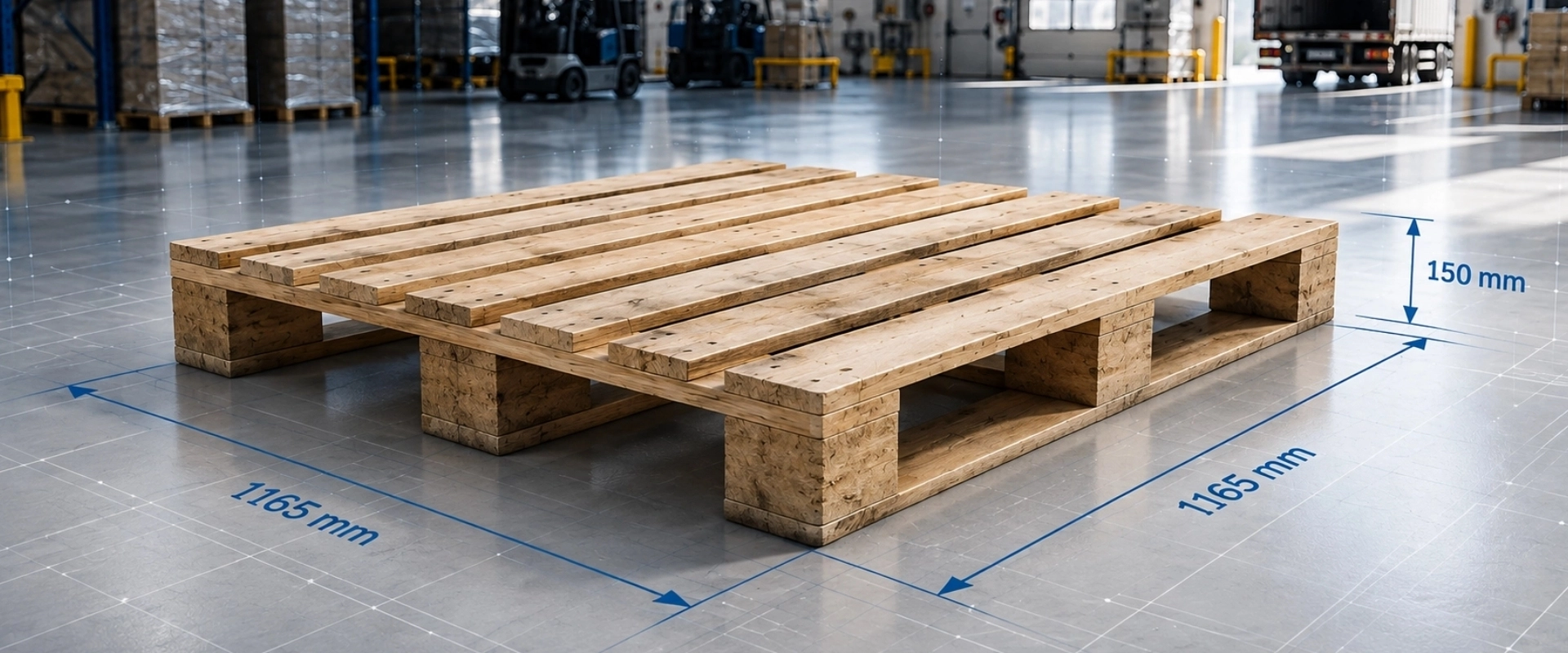
The standard pallet size in Australia is 1165mm x 1165mm x 150mm high, a square format built around the country's rail, road and warehouse racking systems, not the international ISO or Euro formats. This guide breaks down standard pallet dimensions, specifications, weight and measurement methods, compares Australian sizes against Euro, ISO, US and UK pallets, and shows you how to choose the right standard pallet size for warehousing, export, retail or manufacturing.
Key Points:
- Australia's standard pallet size is 1165mm x 1165mm x 150mm unique in the world.
- CHEP and Loscam pooled pallets are both built to this Australian standard.
- Export pallets typically shrink to 1100mm x 1100mm to fit ISO shipping containers.
- Standard pallet weight ranges from roughly 20kg to 40kg depending on material and build.
- The right standard pallet size depends on your industry, racking system and freight destination.
Introduction
Anyone who has tried to book freight, design a racking layout, or ship goods interstate has hit the same question: what size pallet do I actually need? Get the standard pallet size wrong and you risk wasted warehouse space, rejected freight bookings, or racking that simply doesn't fit.
Pallets matter more to the Australian economy than most people realise. The local pallet market was valued at roughly USD 1,373.4 million in 2025 and is forecast to keep growing at close to 3.9% a year through to 2034, driven by e-commerce growth, export volumes and warehouse automation.
In this guide, we will cover exactly what the standard pallet size in Australia is, how it compares internationally, what the official specifications require, how much a pallet weighs, how to measure one correctly, and how to choose the right size for your business.
What Are Standard Pallet Sizes?
Definition of a Standard Pallet
A standard pallet is a flat, load-bearing platform usually timber, plastic or metal built to a fixed, industry-agreed footprint so it works reliably with forklifts, pallet jacks, racking and transport vehicles. "Standard" simply means the dimensions are consistent across an entire market, so a pallet made by one supplier will fit the racking, trucks and containers used by everyone else in that market.
Why Pallet Dimensions Matter
Pallet dimensions decide almost everything downstream: how many units fit on a truck, how racking bays are engineered, how much floor space a warehouse needs, and whether a load will fit inside a shipping container without wasted air. Choosing the right dimensions helps improve freight efficiency, optimise warehouse operations, and support reliable pallet transport solutions. This is why understanding the standard pallet size for your market and how it compares internationally is one of the most practical pieces of knowledge in logistics and warehousing.
Standard Pallet Sizes in Australia
Australian standard pallet size
In Australia, the standard pallet size australia businesses default to is 1165mm x 1165mm, with a deck height of roughly 150mm. This square format is unique to Australia and is formalised under AS 4068 (Flat Pallets for Materials Handling). It traces back to the post-war period, when Australia adopted a 46 x 46 inch pallet inspired by US materials handling practice, later converted to today's 1165mm metric equivalent.
CHEP pallet dimensions
CHEP, Australia's largest pallet pooling provider, manufactures both timber and plastic pallets to this exact 1165mm x 1165mm x 150mm specification, with a tare weight of around 38kg for the timber version. With more than 75 points of presence nationally, CHEP's blue-stamped pallets are the ones most Australian warehouses will recognise on the dock.
ISO pallet comparison
Internationally, accepted ISO-aligned sizes include the 1200mm x 1000mm pallet common across Asia-Pacific supply chains. The 1165mm Australian pallet doesn't align directly with ISO shipping container modules, which is why export shipments typically move on a different, smaller pallet.
Standard Pallet Dimensions
1. Australian standard pallet length
The standard pallet length in Australia is 1165mm. Because the Australian pallet is square, the length and width are identical. Unlike the Euro pallet (1200mm x 800mm) or the North American pallet (1219mm x 1016mm), which are both rectangular.
2. Australian standard pallet width
Matching the length, the standard pallet width is also 1165mm. This symmetrical footprint means the pallet can be loaded and picked up from any of its four sides, a genuine efficiency advantage in a busy warehouse.
3. Australian standard pallet height
Standard pallet height sits at approximately 150mm for the deck structure itself. Total stack height on top of that will obviously vary depending on what's loaded.
4. Australian standard pallet height dimensions
When suppliers refer to full standard pallet height dimensions, they usually mean the base pallet height (150mm) plus whatever sits on top of it. For racking design, most warehouse teams allow for the 150mm deck, the tallest expected load height, and a safety clearance margin.

Standard Pallet Specifications
Australian standard pallet specifications are set out in AS 4068-1993 (Flat Pallets for Materials Handling), which although formally withdrawn in 2019. Remains the benchmark most manufacturers and retailers still build and audit against.
- Material: Softwood (pine) for cost-effective, single-use or short-rotation pallets, hardwood for durability and repeated pooling use (CHEP, Loscam), food-grade HDPE or PP for plastic pallets used in hygiene-sensitive industries.
- Load capacity: Typically 500kg to 2,000kg static load for a standard timber pallet, depending on board thickness and construction quality, heavy-duty builds can exceed this.
- Construction: Either stringer pallets (parallel timber beams supporting the deck) or block pallets (solid corner and centre blocks that allow four-way forklift entry).
- Deck boards: Top boards must be a maximum of 150mm wide and a minimum of 22mm thick, with no more than 50% of any board's width taken up by knots or holes.
- Entry type: Most Australian standard pallets are four-way entry, meaning a forklift or pallet jack can lift the load from any of the four sides, a direct benefit of the square footprint.
Standard Pallet Measurements
Accurate pallet measurements are essential whenever you are quoting freight, specifying racking or checking a supplier's compliance. There are five figures worth knowing for any standard pallet:
- Length: 1165mm for the Australian standard pallet.
- Width: 1165mm, matching the length in the square Australian format.
- Height: Up to 150mm overall, measured from the base of the bottom deck to the top of the top deck boards.
- Thickness: Individual deck boards are a minimum of 22mm thick, with the internal support structure adding to overall height.
- Weight: An empty (unloaded) Australian standard pallet typically weighs between 20kg and 40kg, depending on material and build quality.
Standard Pallet Weight
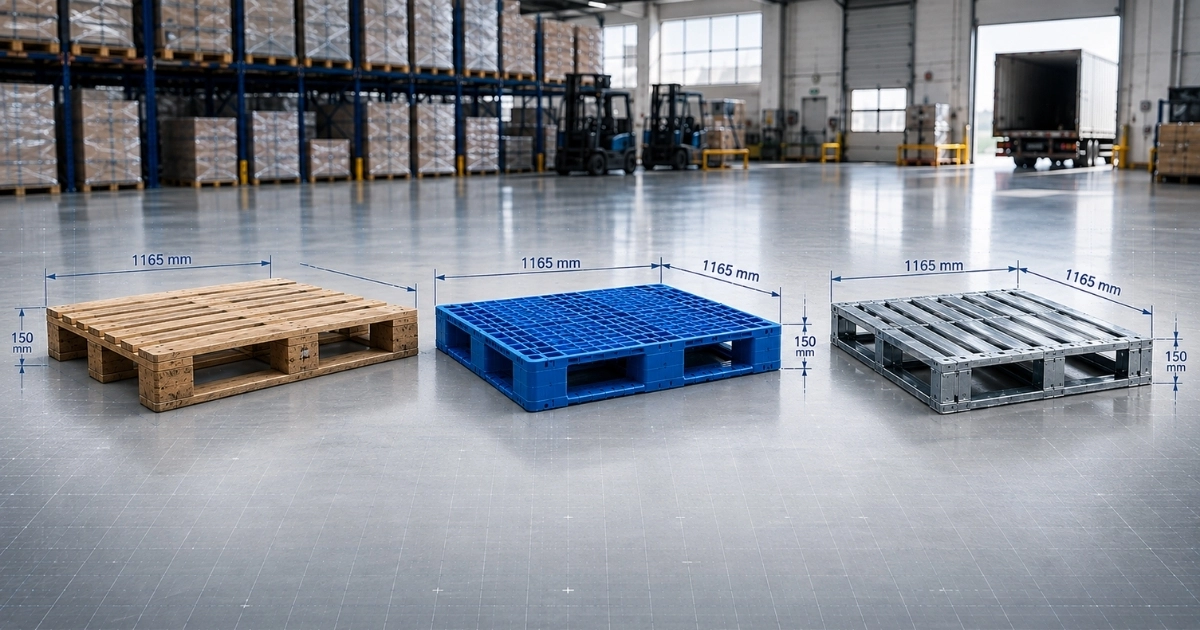
Standard pallet weight varies by material, and it is a figure worth checking carefully. It affects everything from freight cost calculations to how many pallets a truck or container can carry before hitting a weight limit, not just a space limit.
i. Wooden Pallet Weight
An empty Australian timber pallet built to AS 4068 typically weighs between 30kg and 40kg. CHEP's standard 1165 x 1165mm wooden pallet has a listed tare weight of around 38kg. Weight varies with the type of timber used and the moisture content of the boards, since timber naturally absorbs and releases moisture over its working life.
ii. Plastic Pallet Weight
Plastic pallets are generally lighter and more consistent in weight than timber. CHEP's plastic pallet in the same 1165 x 1165mm footprint has a tare weight of around 29kg, while lighter nestable export-style plastic pallets can weigh significantly less.
iii. Steel Pallet Weight
Steel and other metal pallets are the heaviest option, generally starting well above 40kg and often exceeding this by a significant margin depending on gauge and reinforcement. They are reserved for heavy-duty, high-value or repeated use industrial loads where durability outweighs the extra tare weight automotive components and machinery are typical use cases.

Common Pallet Sizes Used in Australia
These are the common pallet sizes businesses in Australia, whether goods are moving domestically or overseas:
|
Pallet Type |
Dimensions |
|
Australian Standard |
1165 x 1165 mm |
|
Australian Export (ISO Series 1) |
1100 x 1100 mm |
|
Euro Pallet |
1200 x 800 mm |
|
ISO Pallet |
1200 x 1000 mm |
|
North American Pallet |
1219 x 1016 mm |
Typical Pallet Size vs Australian Standard
It helps to separate two ideas that often get confused: the typical pallet size people picture globally, and the standard size pallet actually used in Australia. Internationally, the "typical" reference pallet is usually the rectangular 1200 x 1000mm ISO pallet or the 48 x 40 inch US pallet.
|
Feature |
Typical Global Pallet Size |
Australian Standard Pallet Size |
|
Shape |
Rectangular |
Square |
|
Common dimensions |
1200 x 1000 mm (ISO) / 1200 x 800 mm (Euro) |
1165 x 1165 mm |
|
Height |
Approx. 144–150 mm |
Up to 150 mm |
|
Container fit |
Optimised for 20ft/40ft ISO containers |
Best suited to domestic RACE rail containers |
|
Best used for |
International freight and export |
Domestic Australian warehousing and retail |
Pallet Dimensions Australia vs International Sizes
Here's how pallet dimensions australia businesses use compared with the major international formats:
|
Region |
Standard Dimensions |
Notes |
|
Australia |
1165 × 1165 mm (domestic) / 1100 × 1100 mm (export) |
Square, built for domestic rail (RACE) and road transport |
|
Europe |
1200 × 800 mm |
Euro pallet / EPAL standard |
|
USA |
1219 × 1016 mm (48 × 40 in) |
GMA pallet standard |
|
UK |
1200 × 800 mm |
Follows Euro standard, 1200 × 1000 mm also common in retail |
|
Asia |
1100 × 1100 mm |
Widely used in Japan and Korea, matches Australia's export size |
How to Measure a Standard Pallet
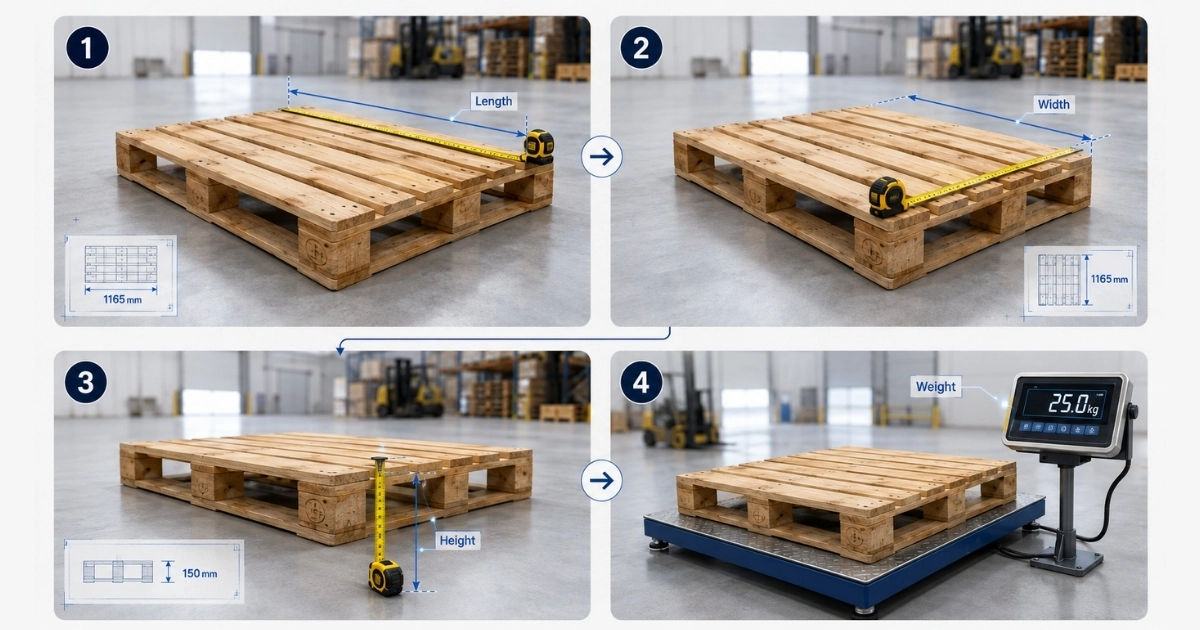
Measuring a pallet correctly takes a few minutes and prevents costly racking or freight mismatches later. Follow these steps:
Step 1: Length
Lay the tape measure along the longest edge of the top deck, corner to corner, and record the figure in millimetres.
Step 2: Width
Measure the adjacent edge at 90 degrees to the length. On an Australian standard pallet this should match the length almost exactly, at 1165mm.
Step 3: Height
Measure vertically from the floor to the highest point of the top deck boards, keeping the tape perfectly upright.
Step 4: Weight
Use a pallet scale or platform scale to record the empty weight before it is loaded, so you can separate pallet weight from cargo weight later.
Choosing the Right Standard Pallet Size
- Warehousing: match the pallet footprint to your racking beam width and aisle clearances before ordering stock.
- Export: use the 1100mm x 1100mm or ISO-aligned size to fit shipping containers efficiently and stay compliant with ISPM 15 treatment requirements.
- Retail: a standard size pallet in the 1165mm x 1165mm format suits most supermarket and hardware supply chains, including the networks behind major grocery and hardware retailers.
- Manufacturing: heavier-duty steel or reinforced timber pallets handle repeated, high-frequency handling better than lightweight formats.
- Shipping containers: 1100mm x 1100mm pallets typically fit two-across in a standard 20ft or 40ft container more efficiently than the 1165mm domestic size.

Conclusion
The dimensions of a standard pallet in Australia 1165mm x 1165mm x 150mm are unlike any other market in the world, and that single fact shapes racking design, freight planning and export compliance across the entire supply chain. Whether you are stocking a warehouse, quoting a freight lane, or preparing an export shipment, matching your pallet choice to the right standard will save you money, space and handling headaches down the line.