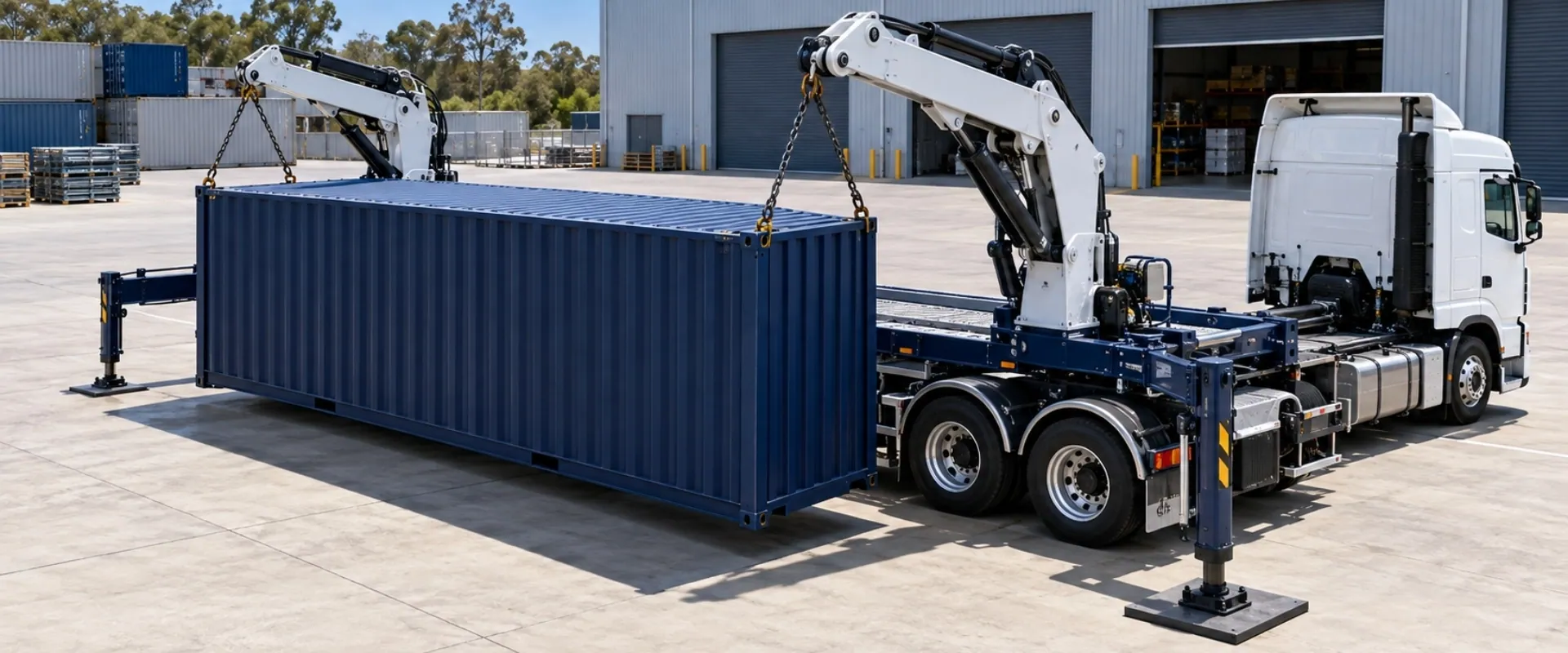
All the Highlights, No Fluff
Side loader container transport is the delivery of a shipping container by a truck that can lift the box off the ground, carry it, and set it back down at the other end using its own hydraulic cranes. You don’t need a forklift, a crane or a loading dock at either end. That is why it is so common in Australia, where plenty of delivery sites have no unloading equipment at all.
A side loader usually handles 20ft and 40ft containers, loaded or empty, within weight limits. It unloads to the driver’s side, needs a flat, firm and clear strip of ground, and carries a lighter maximum payload than a standard skel trailer. Price depends on distance, container size and weight, site access and how long the driver waits on site.
Introduction
Most of what ends up on Australian shelves and building sites arrives in a steel box. The Bureau of Infrastructure and Transport Research Economics reports that 9.1 million TEUs (twenty-foot equivalent units) were exchanged at the container terminals in Brisbane, Sydney, Melbourne, Fremantle and Adelaide in 2024-25. Many of those boxes then have to cover a final stretch by road to a warehouse, factory, farm or building site.
That last stretch is where side loader container transport earns its keep. Industry guides note that sideloaders are far less common in many other countries than they are here, and anyone who has watched a driver swing a 40ft container off a trailer and onto a paddock in a few minutes can see why they became a local favourite.
This guide explains what the service is, how the equipment works, which containers it can carry, what it costs, and what you need to do before the truck arrives. It is written for business owners, site managers and logistics coordinators who have a container to move and want to avoid the common mistakes.
What Is Side Loader Container Transport?
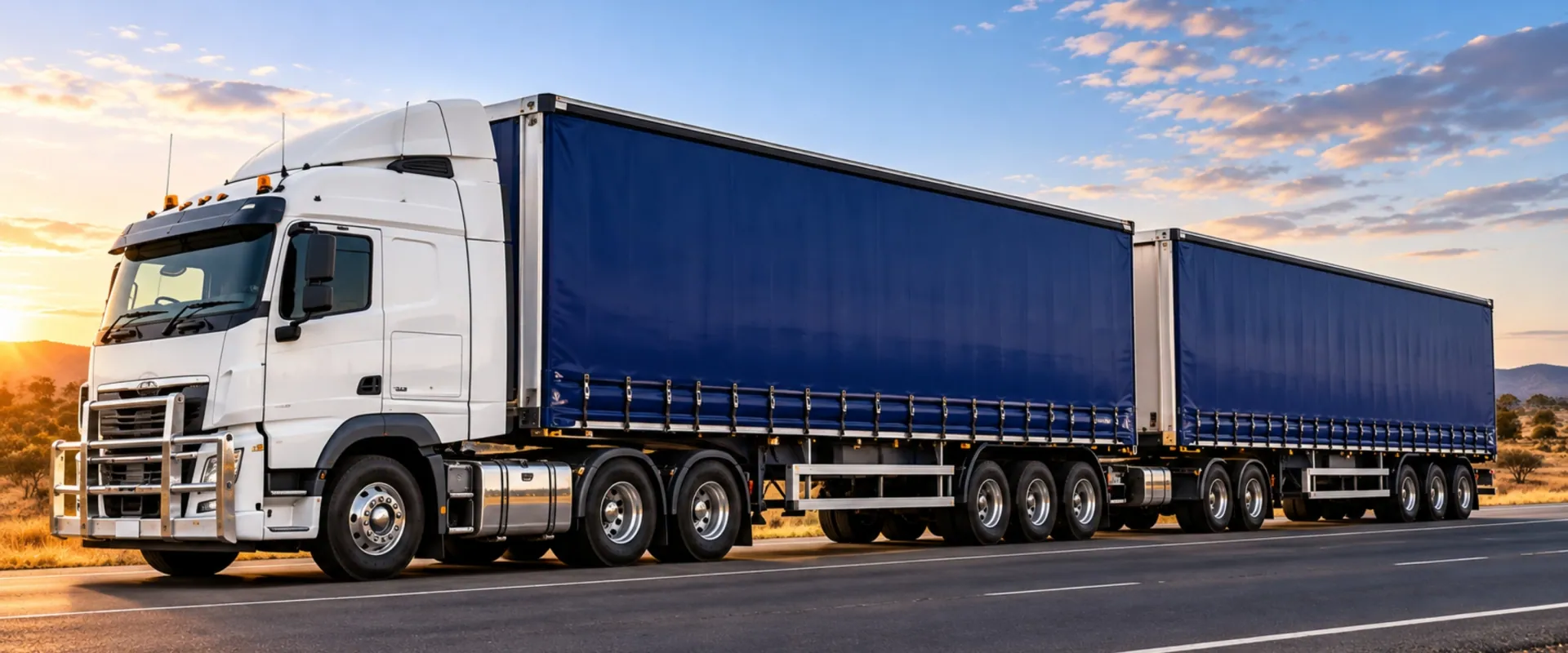
It is a road cartage service where the vehicle carries its own lifting gear. The trailer has two hydraulic cranes, one at each end, that lift a container from the ground onto the trailer bed, hold it for the journey, and lower it back to the ground at the destination. Operators also call these rigs side lifters or swing lifters.
The point is self-sufficiency. A driver can collect a container from a yard, a paddock or a suburban driveway, and drop it at a site that has no crane, no forklift and no raised ramp. Side loader transport is therefore as much a site-access solution as a transport one.
It is worth knowing how it compares with the other common ways to move a container in Australia.
| Method | How it unloads | Best suited to | Watch out for |
|---|---|---|---|
| Side loader | Lifts the container to the ground with its own cranes | Sites with no unloading equipment or tight access | Lower maximum payload; needs clear ground beside the truck |
| Skel trailer | Needs a crane or reach stacker, or a dock | Ports, depots and warehouses with equipment | Not self-unloading, so waiting or extra hire may apply |
| Tilt tray | Tilts and slides the container onto the ground | Lighter 20ft containers and smaller sites | Limits on container size and weight |
| Hiab (truck-mounted crane) | Crane lifts the container off | Awkward sites where other trucks cannot reach | Weight limits make it unsuitable for many full containers |
How Does a Side Loader Truck Work?
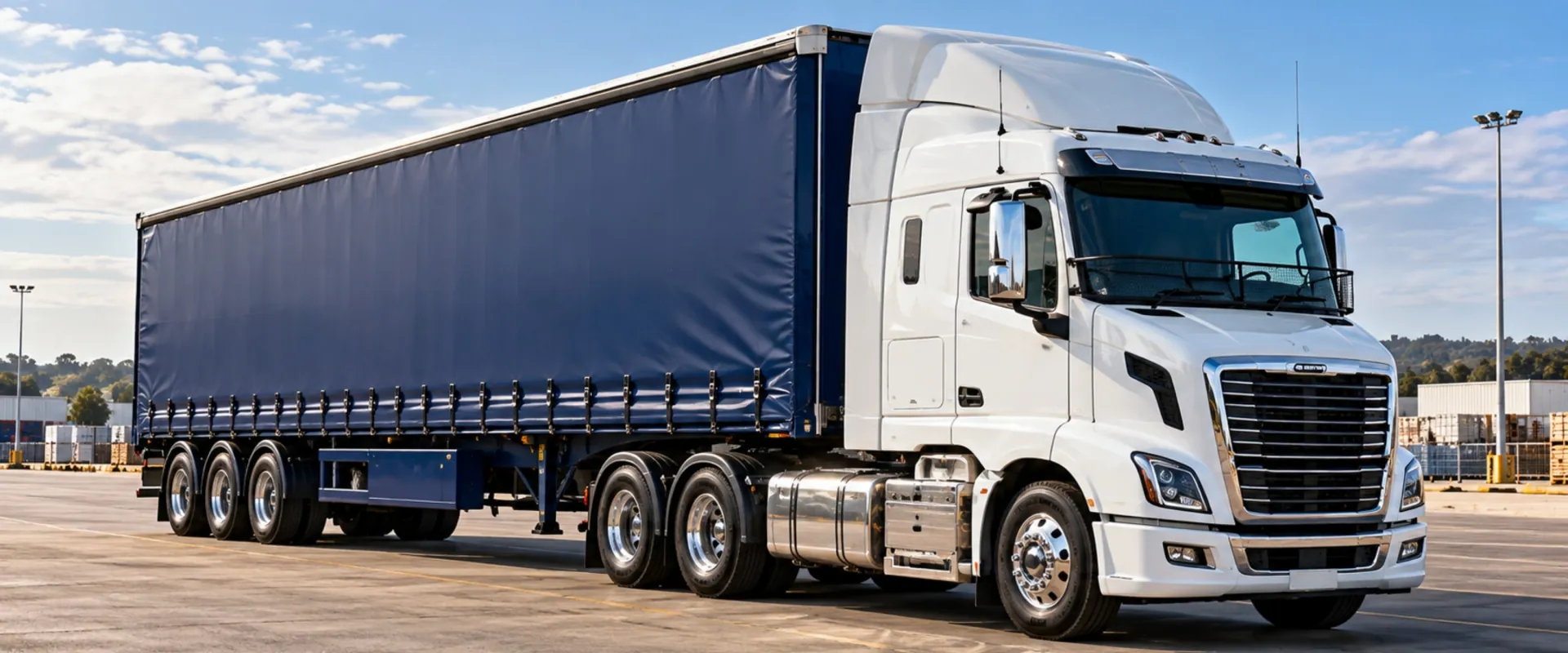
A container side loader is basically a truck with its own crane system. Here is what a typical job looks like from the driver’s seat.
- Positioning: the driver parks the trailer alongside the container, close and parallel, so the cranes can reach it.
- Connecting: the lifting arms lock onto the container’s corner castings, the standard fittings that every ISO container has at its corners.
- Lifting: the two hydraulic cranes raise the container and swing it across onto the trailer bed. The driver controls this from a remote or controls at the rear of the vehicle.
- Securing: the container is locked down with twistlocks before the truck moves.
- Delivery: at the destination, the driver parks alongside the drop point, releases the locks and lowers the container onto the ground.
- Unlocking and leaving: once the container is stable and level, the cranes disconnect and the truck drives off.
What Types of Containers Can a Side Loader Transport?
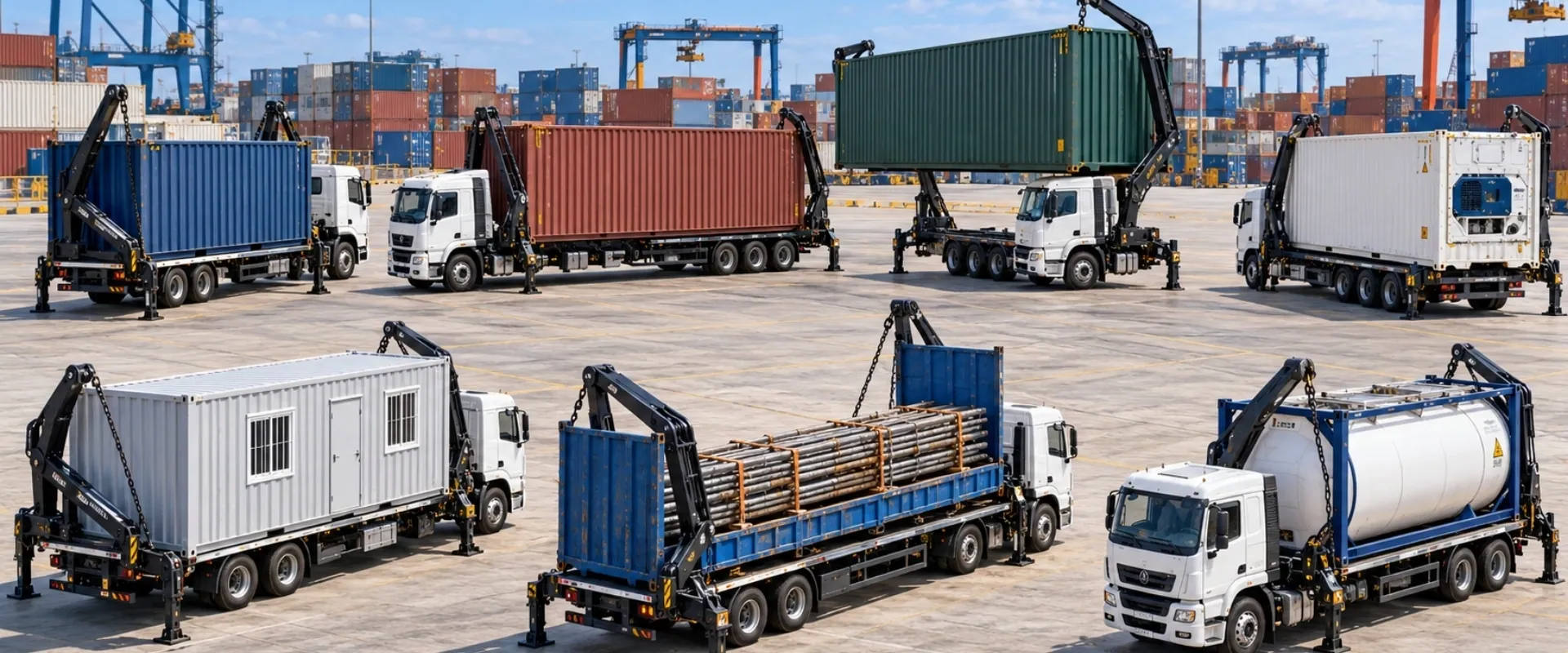
Most modern side lifters can handle the container types you are likely to meet in everyday freight:
| Container type | Can a side loader move it? | What to check first |
|---|---|---|
| 20ft general purpose | Yes, the most common side loader job | Gross weight, especially for dense cargo such as tiles, steel or paper |
| 40ft general purpose | Yes | Room for a full semi-trailer plus the 12.2 m container |
| 40ft high cube | Yes | Overall travel height, low-deck trailers keep it within the 4.3 m general height limit |
| Refrigerated (reefer) | Yes | Suitable power at the drop zone if the unit needs to keep running |
| Open top and flat rack | Usually | Whether cargo overhangs the frame or sits above the lifting points |
| ISO tank | Some models | Tank rating, dangerous goods paperwork and a DG-licensed operator |
| Site offices and modified containers | Usually | Whether added windows, doors or fit-outs have weakened the frame or corner castings |
Key Benefits of Side Loader Container Transport
The container arrives when you need it, sits where you want it and leaves when you’ve finished with it. In practice, that shows up in a few ways:
- No lifting gear needed at your site: you don’t need a forklift, reach stacker, gantry or dock, because the truck brings its own lifting equipment both ways.
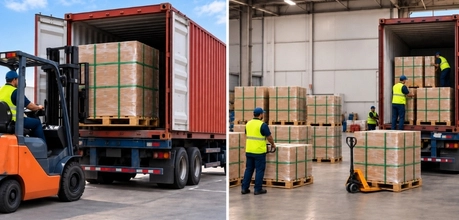
- Unpack at ground level and at your own pace: your team can hand-unload or roll pallets straight off the floor, instead of rushing to finish while a truck sits on waiting time.
- Works where other trucks can’t: a side loader needs room alongside, not behind, so it often suits long, narrow sites where a tilt tray has nowhere to slide the box off.
- Less double handling: delivering straight to your door avoids an extra lift at a container park and a day’s storage you would otherwise be paying for.
- Gentler on cargo: the lift speed is controlled, which matters for fragile goods, machinery and fitted-out containers.
- Safer unloading: with the container on the ground, nobody is working off a trailer deck or a makeshift ramp, and the operator controls the lift from a safe distance.
- One service for delivery and collection: the same side loader transport job that drops the full box can collect the empty, which keeps returns simple and helps you stay inside the shipping line’s free days.
When Should Businesses Use Side Loader Container Transport?
Side loader transport makes the most sense when the container needs to stay put for a while, or when your site simply can’t handle a container any other way. It’s
- Delivering a container to a site with no forklift, crane or dock the core use case
- Shipping container sales and hire deliveries to end customers
- Site offices, ablution blocks and storage containers for construction projects
- Moving import containers from the wharf or container freight station direct to a site for unpacking
- Farm, rural and regional deliveries where the nearest container handler is hours away
- Mining and resources site supply and demobilisation
- Relocating a container from one part of a site to another, or between sites
- Self-storage and container storage yard operations
- Event and temporary infrastructure set-up and pack-down
How Much Does Side Loader Container Transport Cost in Australia?
There is no single published price, and any article that quotes one flat figure is guessing. It is quoted job by job because the cost depends on a handful of variables:
| Cost factor | Why it matters |
|---|---|
| Distance | Metro runs are often priced per trip, longer and interstate runs are priced by distance |
| Container size and weight | A heavy 40ft box uses more of the truck’s capacity than an empty 20ft |
| Pickup location | Port and terminal pickups can add fees and strict time windows |
| Site access | Tight sites take longer to position and unload |
| Waiting time | Delays at the pick-up or delivery point are usually charged |
| Time of day | After-hours, weekend and public holiday work often costs more |
| Extras | Tolls, fuel surcharges, reefer power, empty container return |
How to Prepare for a Side Loader Container Delivery
1. Check what is overhead
This is the one that stops jobs most often and it is the one with genuine safety consequences. The cranes swing high above the trailer, and there must be nothing above the lift zone, no powerlines, no telephone cables, no tree branches, no awnings, no carport or shed roof overhang. Minimum approach distances to overhead electrical assets are set by each state’s regulator and are not negotiable by the driver. If there are powerlines anywhere near the drop zone, tell your operator at the time of booking.
2. Confirm you have enough space
As a working guide, allow around four to five metres of clear space beside the truck for the stabiliser legs, giving a total working width commonly in the eight to ten metre range including the vehicle itself. You also need enough length to get a 19-metre combination in, positioned and back out again. Confirm the exact figures with your operator, because they vary by unit.
3. Assess the ground
Most modern side lifters can handle the
The stabiliser legs concentrate the entire load of the truck and container onto a small number of pads. Ground that looks solid may not be. Watch for soft or recently filled ground, wet or boggy areas, freshly laid asphalt in hot weather, pavers and decorative surfaces that will crack, and anything sitting over a drain, pit, septic tank or underground service. If you are unsure what is under the surface, say so a collapsed service line is a far more expensive problem than a rescheduled delivery.
4. Make sure the surface is level
Containers need to sit level to stay structurally sound and to let the doors open and close properly. A sloped or uneven drop zone causes the frame to twist, and twisted containers do not seal.
5. Clear the access route and the drop zone
Move vehicles, skips, materials, pallets and anything else out of both the driving line and the lifting area. Let staff and other contractors know the delivery is happening so the area stays clear.
6. Mark the exact placement
Paint, pegs, witches hats anything visible. The driver places it where you indicate, and moving it afterwards means another chargeable lift.
7. Confirm weight and access details at booking
Declare the gross weight, note any access restrictions, height limits, gate widths or site induction requirements, and confirm who will be on site to direct the placement.
Conclusion
A container side loader solves a simple problem: getting a box onto the ground where there is no equipment to lift it. That makes it the default choice for many Australian farms, building sites, small businesses and depots, even though it costs more than a skel trailer in some cases and carries a lighter maximum payload.
Choose it when your site lacks lifting gear or has tight access, give your carrier accurate weights and site details, and prepare the drop area properly. Do those three things and the delivery is usually quick and uneventful.