
Quick Summary
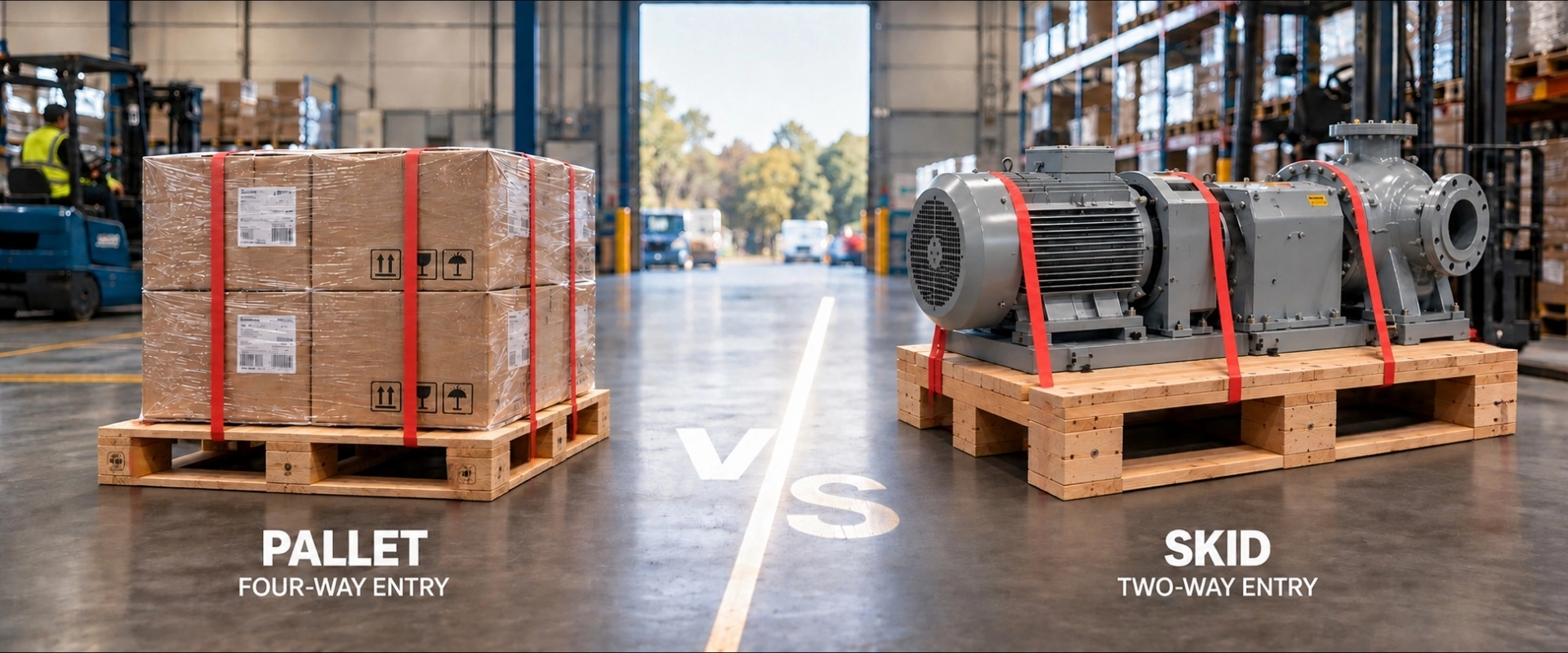
A pallet has a top deck and a bottom deck, so a forklift or pallet jack can enter from all four sides. A skid has a top deck only, resting on runners, which allows entry from two sides and lets the load be dragged. In the skid vs pallet decision, pallets suit stackable, repeatable freight moving through Australian warehouses, while skids suit heavy machinery, oversized items and one-way shipments that need a stable base rather than frequent handling.
Introduction
Australia’s domestic freight task reached an estimated 786 billion tonne-kilometres in 2024–25, with road freight accounting for approximately 253 billion tonne-kilometres. Road transport also carried almost 80% of Australia’s non-bulk freight, according to the Bureau of Infrastructure and Transport Research Economics (BITRE) and Infrastructure Australia.
Every carton, drum and crate moving through the freight network needs a stable base for handling and transport. That’s why the skid vs pallet question comes up so often and why choosing the wrong option can affect handling, stability, storage space and freight costs.
In this guide, we explain what skids and pallets are, the key differences between them, when to use each, how costs can vary, and how to choose the right option for your freight.
What Is a Pallet?
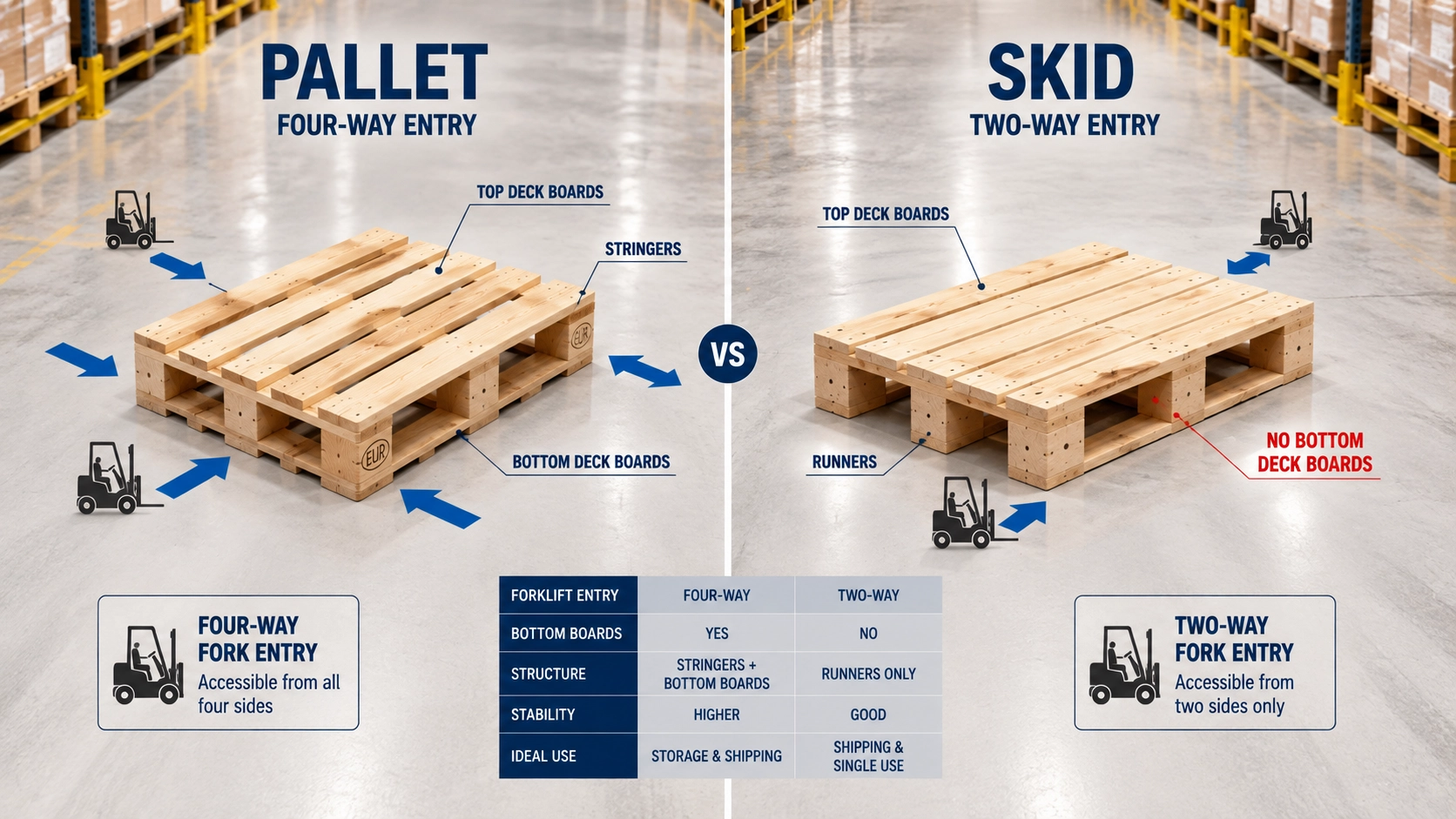
A pallet is a flat, rigid platform built from two decks. The top deck carries the load, the bottom deck sits on the ground, and stringers or blocks separate the two to create the openings a forklift or pallet jack enters through.
That bottom deck is the whole point. It spreads weight evenly across the floor, stops the base from flexing under load, and gives the structure enough rigidity to be stacked one unit on top of another or slid into racking.
Key characteristics:
- Two decks top and bottom joined by stringers or blocks
- Four-way entry on most block pallets, so a forklift can enter from any side
- Designed for repeat use in Australia, often part of a pooling system
- Standard pallet size is 1165 x 1165mm. The Euro pallet at 1200 x 1000mm and the export pallet at 1200 x 1000mm are also common
- Available in timber, plastic and metal, with timber the most widely used
What Is a Skid?
A skid is a platform with a top deck only, supported on runners or stringers underneath. There is no bottom deck. Strip the bottom boards off a pallet and what remains is essentially a skid which is exactly why the two get confused.
Skids came first. They were in use long before the modern pallet, back when loads were dragged rather than forked, and that heritage still shapes where they are useful. Because there is no bottom deck, a skid can be dragged, winched or slid across a floor without catching, and it sits lower, giving a marginally lower centre of gravity for tall or top-heavy items.
Key characteristics:
- Single top deck sitting on runners no bottom deck
- Usually two-way entry, so forklift direction matters
- Lighter and cheaper to produce than an equivalent pallet
- Cannot be reliably stacked, because there is no bottom deck to bear the load above
- Often built to a custom size to match the item bolted to it
Skid vs Pallet: What’s the Difference?
The difference between skid and pallet comes down to one structural decision whether there is a bottom deck and everything else follows from it.
1. Deck construction
A pallet has two decks. A skid has one. That bottom deck spreads load, adds rigidity and creates a defined pocket for forklift tines.
2. Entry direction
Pallets offer four-way entry, so a forklift can approach from any side. Skids offer two-way entry along the runners only. On a congested dock where trailers are loaded nose to tail, four-way entry saves real minutes per pallet.
3. Stability and stacking
The bottom deck gives a pallet a broad, even bearing surface, which is what makes stacking possible. Skids concentrate the load onto two runners. They are extremely stable sitting on a concrete floor under a heavy machine, but they are not designed to be stacked on top of each other.
4. Movability
Skids can be dragged. That sounds trivial until you are positioning a two-tonne compressor inside a plant room with no forklift clearance. A pallet dragged across a floor will catch its bottom boards and break apart.
5. Height and cubic space
A skid is lower, typically by 25 to 50 mm. Across a full container or a B-double trailer, that reclaimed height can be the difference between fitting your consignment and paying for a second vehicle.
6. Standardisation
Pallets are standardised, poolable and interchangeable. Skids are usually bespoke. That single distinction shapes almost every downstream cost.
Skid vs Pallet: Key Differences at a Glance
The table below compares a skid and pallet across the six factors that most affect Australian freight decisions.
|
Factor |
Pallet |
Skid |
|
Deck construction |
Top and bottom deck with stringers or blocks |
Top deck only, supported by runners |
|
Size |
Standardised 1165 x 1165 mm Australian Standard; ISO and Euro sizes also used |
No standard size. Usually custom-built to suit the equipment footprint |
|
Handling |
Four-way entry forklift or pallet jack from any side |
Two-way entry along runners; can be dragged, winched or craned |
|
Stability |
High. Even weight distribution across the full base |
High under a fixed heavy load, but concentrated onto two runners |
|
Stackability |
Designed to stack in racking and in transit |
Generally not stackable |
|
Cost |
Lower per unit, reusable, repairable and available on pooled hire |
Higher per unit when custom-built; usually a one-way cost |
|
Storage |
Space-efficient. Racks and nests predictably in warehouses |
Bulkier to store empty; lower profile when loaded |
|
Weight |
Heavier due to the second deck |
Lighter, which can reduce chargeable weight |
|
Freight use |
General freight, palletised goods, retail and FMCG, LTL consignments |
Machinery, industrial plant, oversized and one-way shipments |
|
Reusability |
High returned, exchanged or pooled |
Low typically single-use or retained by the receiver |
When Should You Use a Skid for Freight?
- A skid is the right choice more often than most shippers realise. Reach for one when:
- You are shipping heavy machinery or plant equipment that will be bolted to the base and stay there
- The load will be dragged, winched or slid into position rather than only forked
- The item is oversized or an unusual shape and needs a custom-built base anyway
- It is a one-way shipment and the base will not be coming back
- You need to keep total shipped weight down, particularly on air freight or long-haul road
- The load is tall and a lower profile helps with height clearance or stability
When Should You Use a Pallet for Freight?
A pallet transport solution is the default for the majority of general freight. Choose one when:
- Your freight needs to be stacked in a trailer or double-stacked in storage
- The goods will be racked in a warehouse or third-party distribution centre
- You are delivering into a major retailer or DC that specifies pooled pallets
- The load will be handled multiple times across several sites
- Forklift operators need to approach from any direction in a tight dock
- You want a standard footprint that carriers can plan trailer space around
Skid vs Pallet: Which Is More Cost-Effective?
The honest answer is that a pallet almost always wins on unit price, while a skid can win on total landed cost for the right load. Judging the skid vs pallet decision on the purchase price alone is where most shippers go wrong.
1. Purchase and hire cost
A standard timber pallet is inexpensive, widely available and often recoverable. Pooled hire through CHEP or Loscam removes the capital cost entirely and replaces it with a per-movement charge. A custom-fabricated skid costs more up front because someone has to build it to your dimensions, and you rarely get it back.
2. Chargeable weight and cubic space
Australian carriers charge on the greater of actual weight or cubic weight. A skid is lighter and lower, so a skid-mounted load can genuinely reduce chargeable dimensions. Conversely, a half-empty pallet means you are paying for air. If your goods do not fill a standard footprint, the pallet is quietly costing you money on every consignment.
3. Handling and labour
Four-way entry is faster. Faster loading means less time on the dock, fewer detention charges and lower handling fees. Skids take longer to position because the forklift has to line up with the runners, and that time appears on your invoice at busy depots.
4. Storage and warehousing
Pallets stack and rack, so they use vertical space. Skids sit on the floor. In a warehouse charging by the pallet space or square metre, that difference compounds every month the stock sits still.
5. Damage and claims
An unstable base is the leading cause of avoidable transit damage. A machine bolted to a properly engineered skid is far less likely to shift than the same machine strapped to a pallet that was never rated for the load. One prevented claim can outweigh years of packaging savings.
Skid vs Pallet for Freight Shipping
Once your goods enter the transport network, the pallet vs skid choice affects far more than the loading dock.
1. Less-than-load and shared freight
LTL freight shares trailer space with other customers. Palletised consignments are preferred because they are predictable, stackable and quick to handle. Skids on a shared trailer take up a defined floor space that cannot be built over, so carriers often price them accordingly.
2. Full load and dedicated transport
On a dedicated vehicle the calculation changes. If you are paying for the whole trailer anyway, a skid that maximises usable height and secures the load properly is frequently the better engineering decision.
3. Interstate linehaul and cross-docking
Freight moving Sydney to Perth or Melbourne to Brisbane is typically handled several times through depots along the way. Every extra handling event is a risk point. Standard pallets survive multi-touch networks better because every depot in the country is set up to handle them.
4. Container and export freight
For sea freight, internal container height and floor space govern everything. Skids often let you fit a taller item under the container roof. If either the pallet or skid is made of untreated timber and it is leaving Australia, it must comply with ISPM 15 heat treatment or fumigation requirements, and be marked accordingly. Plastic, steel and pressed-wood bases sidestep this entirely.
5. Oversize and restricted loads
Skid-mounted machinery frequently exceeds standard dimensions, which brings permits, route planning and sometimes pilot vehicles into play. Factor this into lead times rather than discovering it the week of dispatch.
How to Choose the Right Option for Your Freight
Work through these six questions and the answer usually presents itself.
- How heavy is the load? Anything over roughly 1,000 kg concentrated in a small footprint deserves a skid or a heavy-duty engineered base, not a standard timber pallet.
- What is the footprint? If it fits comfortably within 1165 x 1165 mm, use a pallet. If it overhangs, a custom skid protects the edges and prevents damage.
- How many times will it be handled? Multiple depots and cross-docks favour pallets. Direct point-to-point delivery opens the door to skids.
- Does it need to stack? If yes, you need a pallet. Skids do not stack.
- How will it be unloaded at the other end? Forklift access from all sides means a pallet. Crane lift, drag or winch means a skid.
- Is the base coming back? Returnable and poolable equipment favours pallets. One-way shipments make custom skids far easier to justify.
Common Mistakes When Choosing a Skid or Pallet
- Stacking a skid. There is no bottom deck to carry the load above, and the result is crushed goods at the bottom of the stack.
- Ignoring forklift entry direction. A two-way skid approached from the wrong side wastes time at best and damages the base at worst.
- Overloading a skid beyond its rated capacity, on the assumption it behaves like a pallet.
- Using untreated timber for export freight and having the consignment held at the border.
- Building a custom base that does not fit the trailer footprint, wasting deck space you have already paid for.
- Choosing on unit price alone without considering whether the freight can be stacked.
Conclusion: Choosing the Right Skid or Pallet for Your Freight
The skid vs pallet decision is not about which is better. It is about which suits the load in front of you. Pallets are the right answer for stackable, rackable, repeat-handled freight, and they are what most Australian distribution networks are built around. Skids are the right answer for heavy, oversized or permanently mounted items on a one-way journey.
Get it right and your freight moves cleanly through every touch point. Get it wrong and you are paying for damaged stock, wasted deck space or a delivery that gets turned away at the gate. When in doubt, ask your carrier before the load is built rather than after it arrives.