Quick Summary
A Euro pallet measures 1200mm x 800mm x 144mm and is built to the EPAL and UIC 435-2 specification used right across the European Union. It's smaller, lighter and squarer in profile than Australia's own standard pallet, which sits at 1165mm x 1165mm, and that difference matters the moment you're importing European machinery, exporting on a Euro-compatible lane, or simply running a warehouse that receives stock from both markets. This guide walks through Euro pallet dimensions and sizes, the different Euro pallet types, how a Euro pallet stacks up against the Australian standard pallet, and what you need to get right before one leaves your dock.
Key Points:
- Standard euro pallet size: 1200mm (L) x 800mm (W) x 144mm (H)
- Empty weight: roughly 20-25kg
- Static load capacity: up to 4,000kg; dynamic load around 1,500kg
- Entry: four-way, block-style construction
- Fits approximately 25 Euro pallets in a standard 40-foot container (single layer)
Introduction
Euro pallets are widely used across international supply chains, particularly for European imports, exports and commercial freight. Their standardised design makes them easier to handle, store and transport across different logistics networks.
For Australian businesses, understanding the Euro pallet size, dimensions, load capacity and freight requirements is important when receiving imported goods or preparing palletised freight transport. A standard Euro pallet measures 1,200mm × 800mm × 144mm, which differs significantly from the Australian standard pallet footprint.
These differences can affect truck and container loading, warehouse space, freight costs and pallet handling. This guide explains Euro pallet dimensions and sizes, the different pallet types, how Euro pallets compare with Australian standard pallets, and what to check before transporting your freight.
What Is a Euro Pallet
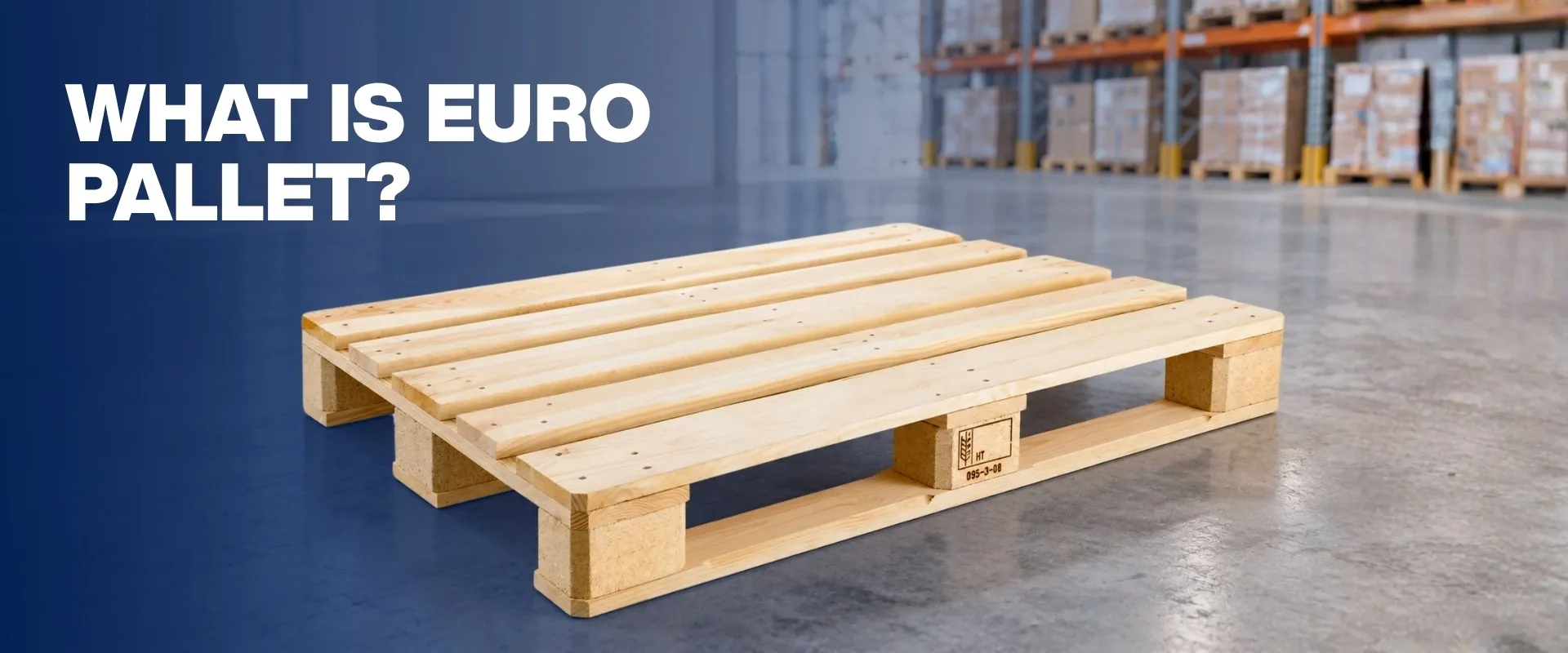
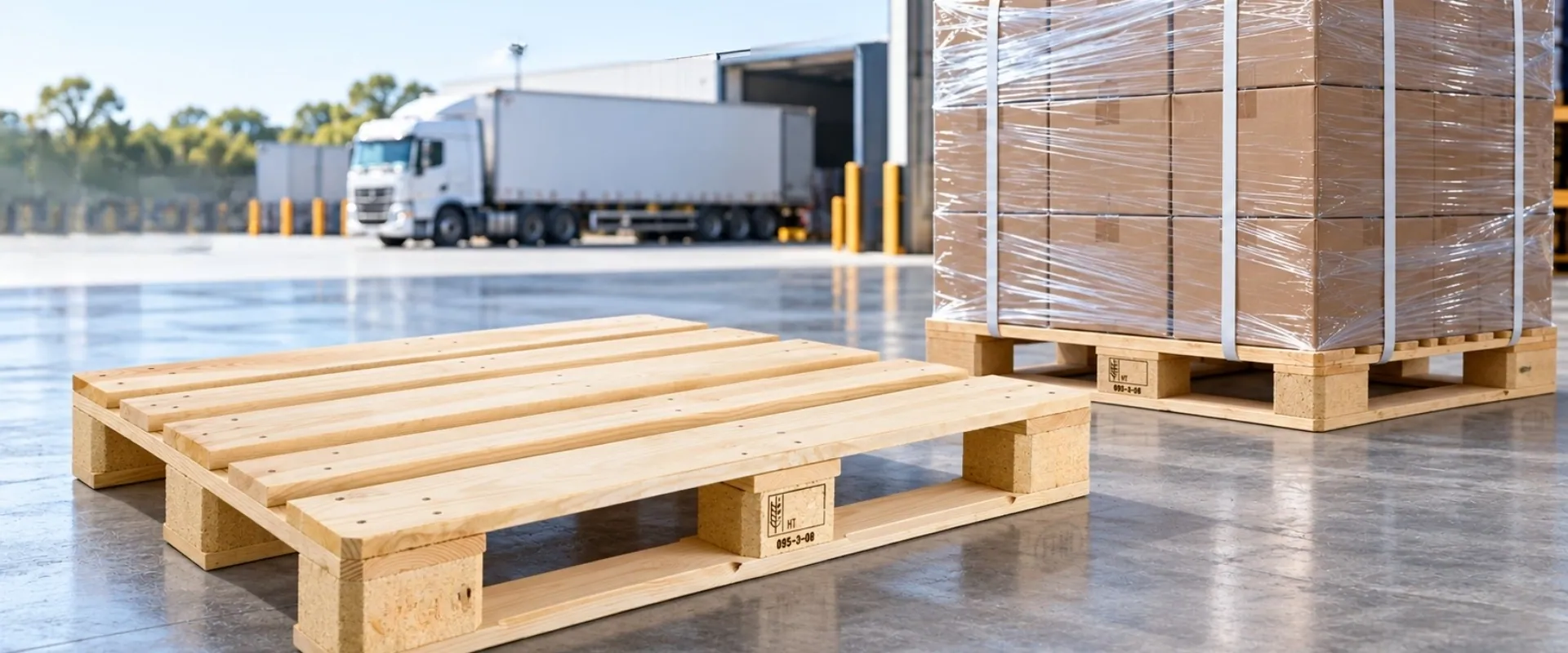
A Euro pallet is a standardised four-way entry timber pallet manufactured to a licensed specification, originally under UIC standard 435-2 and now administered by the European Pallet Association, known as EPAL.
What separates it from a generic timber pallet is that the specification is exact and enforced. Every genuine Euro pallet has the same eleven deck boards, the same nine support blocks, the same nailing pattern and the same chamfered board edges. Because the build is identical everywhere, a pallet made in Poland behaves the same in a racking system as one made in Portugal which is what made European pallet pooling and exchange possible in the first place.
Euro Pallet at a Glance
Specification | Detail |
Dimensions | 1200 mm × 800 mm × 144 mm (length × width × height) |
Weight | Approximately 25 kg |
Footprint area | 0.96 m² |
Material | Kiln-dried softwood or hardwood, heat treated |
Construction | 11 deck boards, 9 blocks, 78 nails to a fixed pattern |
Entry | Four-way forklift and pallet jack accessible from all sides |
Static load capacity | Up to around 4,000 kg (stationary, on a flat surface) |
Dynamic load capacity | Up to around 1,500 kg (being moved by forklift) |
Racking load capacity | Around 1,000 kg (unsupported in racking) |
Marking | EUR or EPAL oval on corner blocks; IPPC and HT stamp on centre block |
Governing body | European Pallet Association (EPAL) |
Australian status | Not the national standard; accepted for transport but outside CHEP and Loscam pooling |
Euro Pallet Dimensions and Sizes
The standard euro pallet size is 1200 mm × 800 mm, but EPAL licenses several variants. If someone tells you a shipment is coming on Euro pallets, it is worth asking which one, because the difference changes how much fits on a truck.
Designation | Dimensions (mm) | Approx. weight | Typical use |
EPAL 1 (EUR / EUR 1) | 1200 × 800 × 144 | 25 kg | The standard Euro pallet — the default across European supply chains |
EPAL 2 (EUR 2) | 1200 × 1000 × 144 | 33 kg | Larger loads; closer to an industrial footprint |
EPAL 3 (EUR 3) | 1000 × 1200 × 144 | 29 kg | Heavy industrial and chemical freight |
EPAL 6 (EUR 6) | 800 × 600 × 144 | 9.5 kg | Half pallet retail display and smaller consignments |
Quarter pallet | 600 × 400 × 144 | Around 5 kg | Point-of-sale displays and small-volume retail |
EPAL CP range | Various | Various | Chemical industry pallets, CP1 through CP9 |
Two euro pallet dimensions details that catch Australian shippers out. First, the 144 mm height is the pallet alone. Your total shipping height includes it, and on Australian cubic conversion pricing that 144 mm is billable space. Second, EPAL 2 and EPAL 3 have the same footprint rotated, so a consignment quoted on "1200 × 1000" pallets may load very differently depending on orientation.
Types of Euro Pallet
Euro pallets are available in several sizes and configurations to suit different freight, storage and handling requirements. The most commonly recognised types are part of the EPAL pallet system, which provides standardised dimensions for efficient handling across supply chains.
1. EPAL 1 Euro Pallet
The EPAL 1 is the standard Euro pallet, measuring 1,200 × 800 mm. It is widely used for general freight, warehousing, distribution and international transport. Its standardised footprint makes it suitable for forklifts, pallet jacks and common handling systems.
2. EPAL 2 Euro Pallet
The EPAL 2 is a larger pallet measuring 1,200 × 1,000 mm. Its wider footprint provides additional loading space and can be useful for larger or heavier goods where the standard Euro pallet does not provide enough surface area.
3. EPAL 3 Euro Pallet
The EPAL 3 measures 1,000 × 1,200 mm and provides a different orientation of the same basic footprint as the EPAL 2. It can be suitable for specific warehouse, handling and freight requirements where the pallet's orientation is important.
4. EPAL 6 Half Pallet
The EPAL 6 is a smaller half pallet measuring 800 × 600 mm. It is useful for smaller shipments, retail distribution and applications where a full-size pallet would provide more capacity than required.
5. Half Euro Pallet
The Half Euro pallet measures 800 × 600 mm, making it half the footprint of a standard 1200 × 800 mm Euro pallet. It is commonly used for smaller loads, retail distribution, display units and shipments where a full-size pallet is unnecessary.
6. Plastic Euro Pallets
Plastic Euro pallets are available in the standard 1200 × 800 mm footprint and are designed for applications requiring durability, consistent dimensions and easy cleaning. They can be particularly useful in supply chains with strict hygiene requirements, including food, pharmaceutical and other controlled environments. Plastic pallet construction can vary by manufacturer and model.
7. CP Pallets
CP pallets (Chemical Pallets) are a separate pallet range developed for the chemical industry. They come in several standardized sizes and specifications designed for different chemical products and packaging types. CP pallets should therefore not be described simply as Euro pallets, even though some CP pallet dimensions are similar to commonly used European pallet footprints.
Euro Pallet vs Australian Standard Pallet
This is the comparison that actually matters if you are operating in Australia.
Factors | Euro pallet (EPAL 1) | Australian standard pallet |
Dimensions | 1200 × 800 mm | 1165 × 1165 mm |
Shape | Rectangular | Square |
Footprint | 0.96 m² | 1.36 m² |
Weight | Around 25 kg | Around 30–40 kg (hardwood) |
Pooling | EPAL exchange — not operating in Australia | CHEP and Loscam hire pools |
Racking fit | Does not match standard Australian racking bays | Australian racking is designed around it |
Where you see it | European imports | Domestic freight, retail and manufacturing |
Ownership | You own it and must dispose of it | Typically hired and returned to the pool |
How to Prepare a Euro Pallet for Transport
Getting euro shipping pallets ready for the road or the wharf comes down to a handful of checks most freight claims trace back to.
- Inspect the pallet before loading. Check for cracked or missing boards, split blocks, protruding nails and any sign of previous repair failure. A pallet that fails in transit damages everything around it, not just its own freight.
- Confirm the ISPM 15 marking. For anything crossing a border, the IPPC stamp with country code and HT must be legible on the centre block. Faded or missing marks are treated as non-compliant.
- Check it is bark free. Australian biosecurity requires timber packaging to be free of bark. This is a common and entirely avoidable cause of holds.
- Build the load within the footprint. Nothing should overhang the pallet edge. Overhang is the leading cause of crush damage in shared loads, because the overhanging carton takes the impact from every adjacent pallet.
- Distribute weight evenly and keep the centre of gravity low. Heaviest cartons on the bottom, lighter on top, weight spread across the deck rather than concentrated over one block.
- Wrap properly. Stretch wrap from the base upward, locking the bottom layer to the pallet itself with several turns around the blocks. A load wrapped only around the cartons will slide off the deck.
- Label clearly and mark non-stackable freight unmistakably. Depot staff building loads to a cut-off will stack to fit unless told otherwise, and a small sticker is not enough.
- Record the height including the pallet. Your carrier bills on total cubic space. The 144 mm pallet is part of what you pay for.
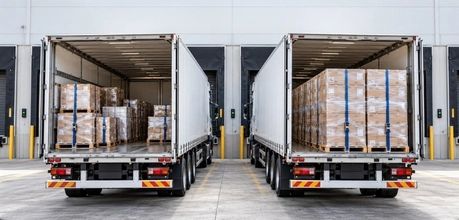
How Many Euro Pallets Fit in a Truck or Container?
Indicative figures for single-tier, floor-loaded pallets. Actual counts vary with deck length, trailer configuration, load restraint requirements and whether the freight can be double-stacked.
Vehicle or container | Euro pallets (1200 × 800) | AU standard (1165 × 1165) | Notes |
20ft shipping container | Around 11 | Around 10 | Internal width is the limiting factor |
40ft shipping container | Around 24 | Around 20 | Doubles the length, not the width |
40ft high cube | Around 24 | Around 20 | Extra height allows double-stacking, not more floor positions |
Rigid truck | 8–18 | 6–14 | Varies widely by body length |
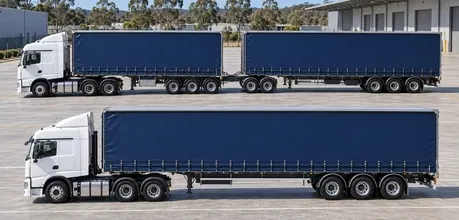
Semi-trailer | Around 33–36 | Around 22 | The most common Australian FTL unit |
B-double | Around 60–66 | Around 34–40 | Approved interstate routes only |
The figure people miss: a semi-trailer takes far more Euro pallets than Australian standard pallets, because the smaller footprint packs more efficiently. But each Euro pallet carries less, so your total payload may not rise proportionally and on dense freight you will hit the weight limit long before you run out of floor space.
Orientation matters too. A 1200 × 800 pallet loaded with the 1200 mm side across the trailer fits two abreast. Turned 90 degrees, three fit abreast. Which one applies depends on your trailer’s internal width and how the load is restrained, so ask your carrier rather than calculating it yourself.
Common Uses for Euro Pallets
Euro pallets turn up across a wide range of Australian supply chains, not just in businesses that trade directly with Europe.
- European imports. By far the most common way Australian businesses encounter machinery, equipment, wine, pharmaceuticals and automotive parts.
- Export freight to Europe. Shipping on Euro pallets makes your consignment easier for European receivers to handle and rack.
- Pharmaceutical and supply chains. Often in plastic form, where hygiene standards and consistent tare weight matter more than cost.
- Retail display. EPAL 6 half pallets and quarter pallets are built for in-store display, and the format carries over to Australian retail promotions.
- Automated warehousing. The rigid specification and consistent dimensions suit conveyor and robotic systems, where tolerance for variation is low.
- Heavy industrial freight. EPAL 2 and EPAL 3 handle loads the standard 1200 × 800 footprint is not sized for.
- Chemical distribution. The CP range was designed specifically for chemical industry packaging and drum configurations.
Conclusion
A Euro pallet is a simple thing to picture once you know the numbers: 1200mm x 800mm x 144mm, four-way entry, EPAL-stamped, and built to behave the same way in every EU country it travels through. The complication only shows up at the border, where it meets Australia's own 1165mm x 1165mm standard pallet and the two systems have to share a warehouse, a truck or a container.
Get the euro pallet size right at the planning stage, confirm ISPM 15 compliance before it ships, and factor the footprint difference into your racking and load planning, and a Euro pallet causes no more trouble than any other. Get it wrong, and it's an easy way to lose floor space, blow out a freight quote, or have a shipment held up at the border.