
Quick Overview
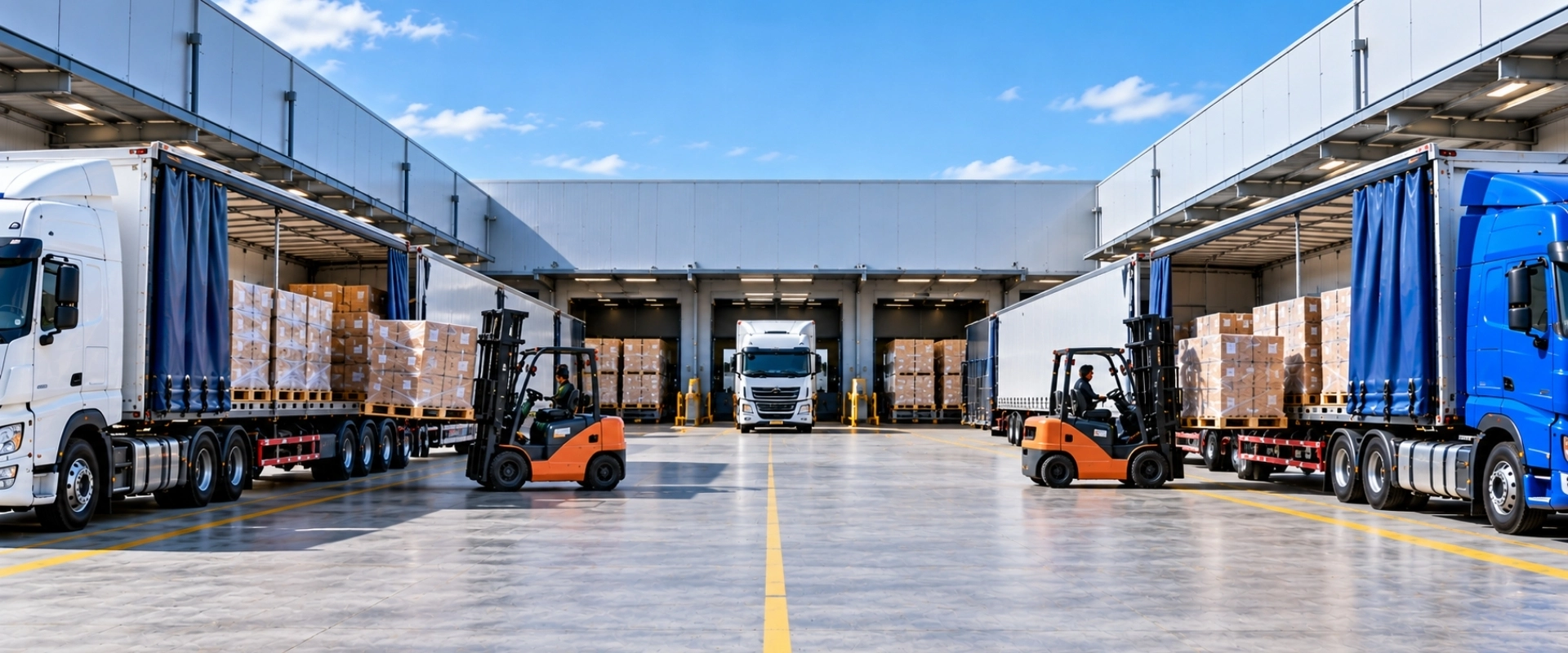
A cross docking warehouse receives goods from inbound trucks or containers and moves them straight across the dock onto outbound vehicles, with little or no storage in between. Instead of putting stock away on shelves, staff unload, sort and consolidate freight by destination, then load it onto the next truck, often within hours of it arriving. Australian retailers such as Woolworths, Kmart and Big Warehouse use this model to keep shelves stocked while cutting handling and storage costs. This guide covers how the process works step by step, the main types of cross-docking, the benefits and challenges, and when the model suits your business.
Introduction
Warehouse space in Australia is tight, and it has been getting tighter. CBRE’s H1 2025 Industrial & Logistics Vacancy Report puts the national industrial and logistics vacancy rate at just 2.8%, one of the lowest levels in the world, with Sydney sitting at 2.4%and Melbourne at 4.1%. When floor space in a distribution centre is this scarce, every square metre needs to earn its keep, and that scarcity is exactly why more Australian businesses are turning to a cross docking warehouse model instead of long-term storage.
Cross-docking flips the usual warehousing pattern on its head. Rather than paying to store products and then pick them again weeks later, goods move from an inbound truck to an outbound truck across the same loading dock, sometimes within hours of arriving. For import heavy supply chains and fast-moving retail categories, that speed can be the difference between hitting a delivery window and missing it altogether.
This guide walks through exactly how a cross docking warehouse operates, the step-by-step process, the different types you will come across, and the benefits and trade-offs worth weighing up before you commit part of your supply chain to the model.
What Is a Cross Docking Warehouse?
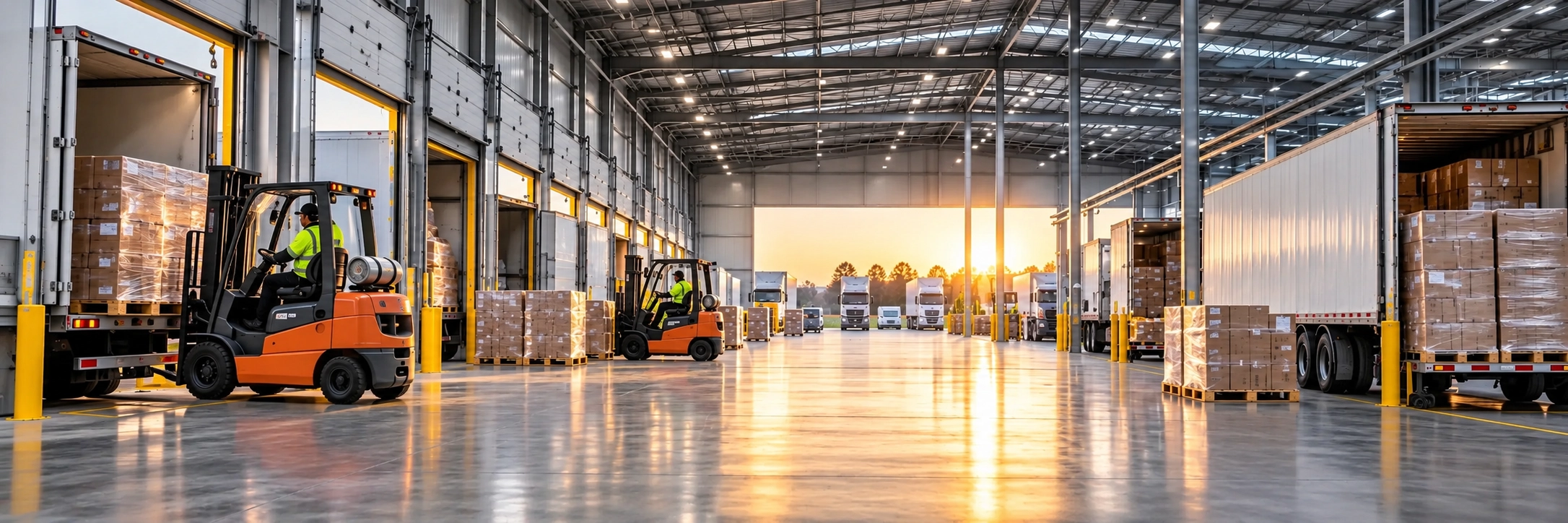
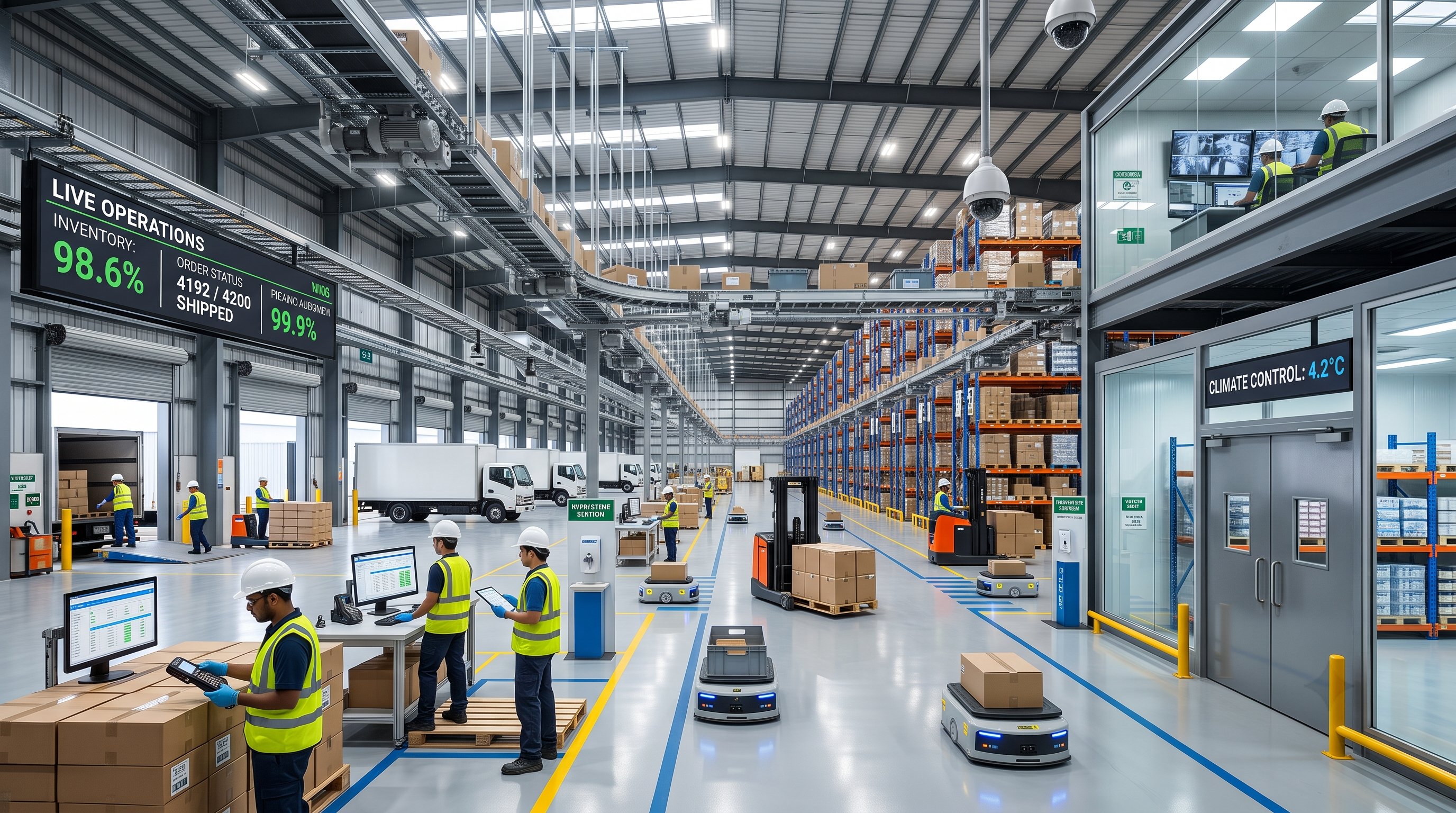
A cross docking warehouse is a logistics facility built for transfer, not storage. Goods arrive from one or more suppliers, get sorted and consolidated by destination, and are loaded straight onto outbound transport, usually without ever being placed into a pallet racking position. Because so little time is spent between the two docks, many operators describe the difference between cross dock and warehousing as the difference between a relay handoff and a locker room, one moves freight through, the other holds onto it.
Most facilities that run this model still keep a small buffer of shelving for products that need to wait a day or two for consolidation, which is why you will sometimes hear the term cross dock warehouse used interchangeably with a hybrid distribution centre. The core idea stays the same minimise dwell time, minimise handling, and get stock moving toward the end customer as fast as the transport schedule allows.
How Does a Cross Docking Warehouse Work?
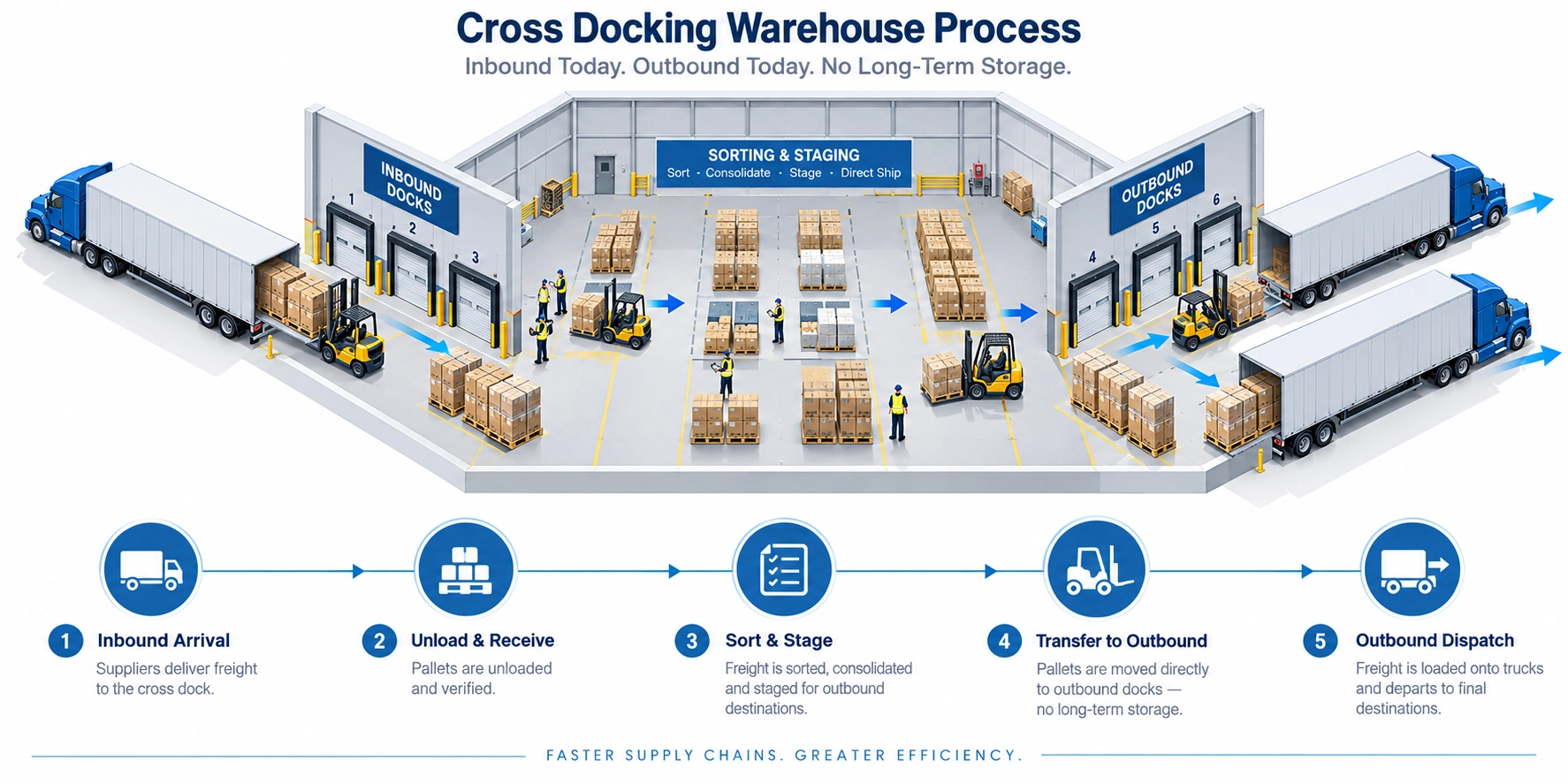
The mechanism is simple in principle and demanding in practice. Inbound and outbound movements are scheduled so that they overlap. Freight arriving in the morning is sorted onto vehicles departing that afternoon, and the floor is clear again by close of business.
Three things make it possible:
- Advance shipment notices (ASNs) that tell the warehouse what’s coming before the truck arrives, so staff know exactly where each pallet needs to go.
- Dock scheduling that lines up inbound and outbound trucks so goods aren’t sitting idle waiting for their next ride.
- A warehouse management system (WMS) that scans, tracks and directs freight across the dock floor in that time, rather than relying on paper pick lists.
Cross-Docking Warehouse Process: Step by Step
Here is how a consignment actually moves through the building.
- Advance Shipment Notice (ASN) and dock scheduling: the supplier sends quantities, SKUs and an expected arrival time before the truck leaves, so staff can book a matching inbound and outbound dock door.
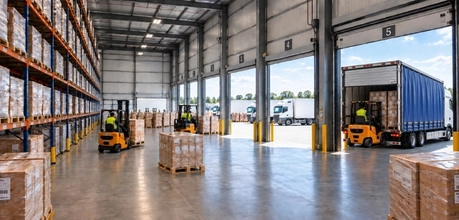
- Inbound receiving: the truck backs onto its assigned dock and is unloaded, usually with a forklift or pallet jack, with each unit scanned against the ASN.
- Inspection and quality check: damaged, mislabelled or incorrect items are pulled aside immediately, temperature and compliance checks happen here for food, pharma or biosecurity-sensitive cargo.
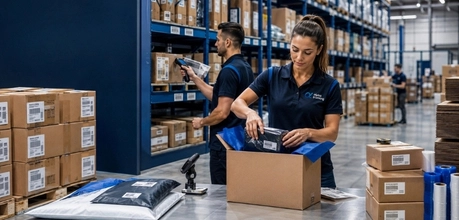
- Sorting and consolidation: verified stock is grouped by destination, order or store and combined with other inbound freight heading the same way. This is the step that actually defines cross-docking, rather than simply unloading a truck.
- Staging: some freight waits in a marked staging lane for a few hours until its outbound truck is ready, rather than being put into long-term storage.
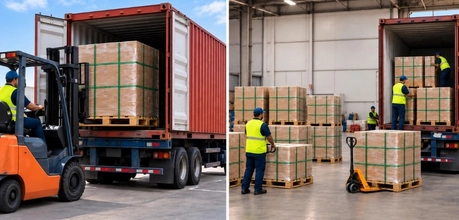
- Outbound loading: ltl consolidated freight is loaded onto the correct outbound vehicle in delivery sequence, so the last pallet on is often the first one off at the far end.
- Dispatch and tracking: the outbound truck departs and the WMS updates constant tracking, so both the business and the end customer can see the shipment is moving.
Types of Cross-Docking
Cross-docking is not one method. The six below solve different problems, and most operations run two or three of them side by side.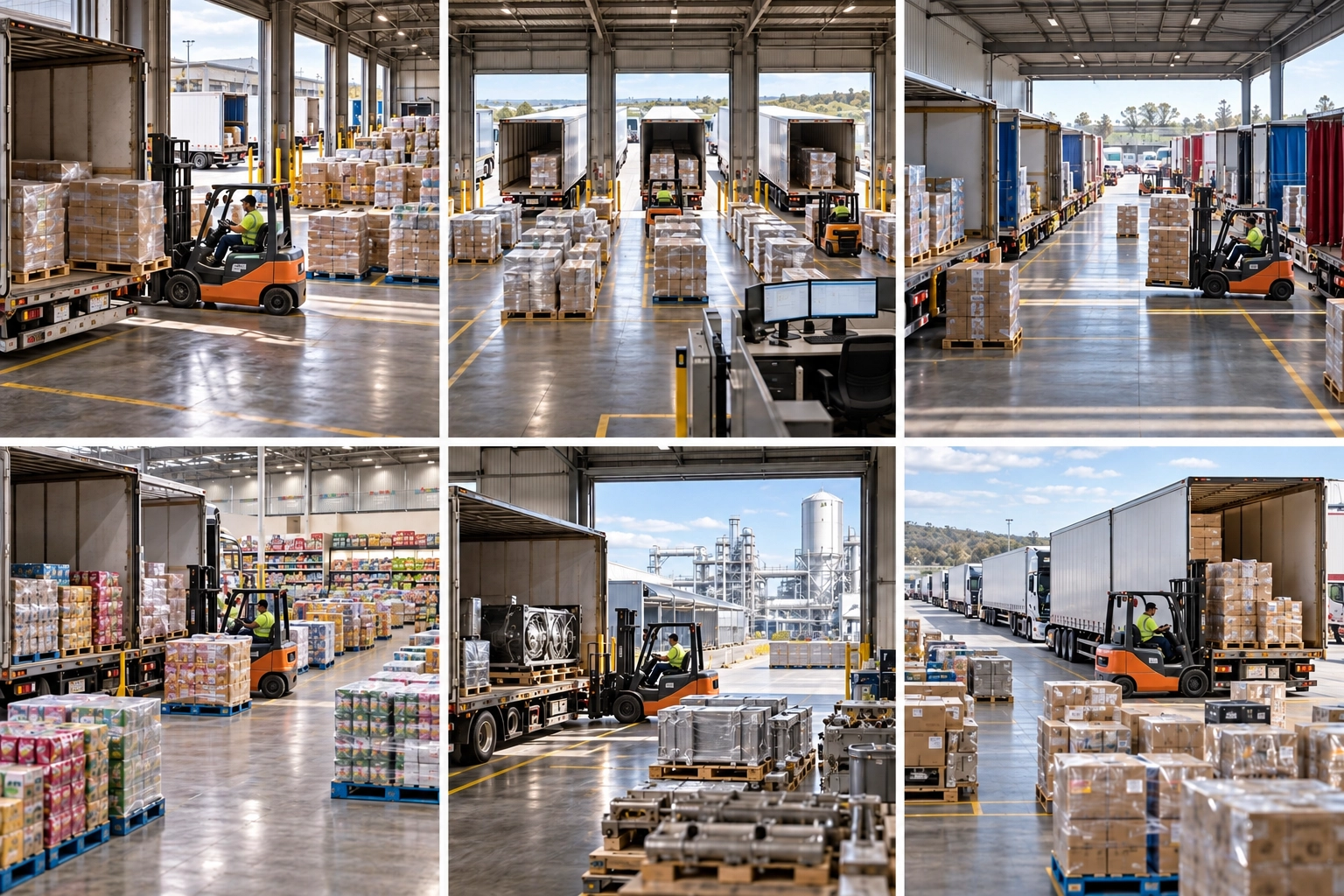
1. Pre-distribution cross-docking
The supplier sorts and labels goods for their final destination before despatch. The cross-dock simply receives, checks and forwards. Fastest and cheapest to run, but it requires the supplier to know final allocation at the point of packing which means good forecasting and a co-operative supplier.
2. Post-distribution cross-docking
Allocation is decided at the dock, based on current demand rather than a forecast made weeks earlier. More responsive and better for volatile demand, but it needs more handling, more floor space and better systems.
3. Distributor cross-docking
Inbound freight from multiple suppliers is combined into single customer orders. Common for trade suppliers and wholesalers whose customers want one delivery rather than six.
4. Retail cross-docking
Product from several suppliers is sorted into store level deliveries. This is what the major Australian grocery and hardware chains run at scale, and it is why a supermarket can carry fresh products with almost no back-of-house storage.
5. Manufacturing cross-docking
Inbound components and raw materials are consolidated and delivered to a production line just in time, removing the need for a separate parts store. Widely used in Australian food processing and fabrication.
6. Transportation (consolidation) cross-docking
Multiple less-than-truckload consignments are combined into full loads for line-haul. Given the distances between Australian capitals, this is often the type with the clearest financial return and it pairs naturally with scheduled interstate services.
Benefits of Cross-Docking for Businesses
- Lower storage cost: The most obvious gain, and the most significant one in the current Australian industrial property market. Freight that does not sit does not need space rented for it.
- Faster delivery: Removing put-away and picking takes days out of the cycle. For businesses competing on lead time, this is often worth more than the cost saving.
- Less handling, fewer claims: A pallet that is received, staged and dispatched is touched far less than one that is put away, picked and re-picked. Damage rates follow handling counts.
- Reduced labour on non-value work: Put-away and picking add no value to the customer. Cross-docking eliminates both for the lines that suit it.
- Better freight economics: Consolidating part loads into full vehicles lowers cost per pallet on long Australian corridors, where line-haul dominates total cost.
- Less capital tied up: Stock that moves straight through is stock you are not financing on a shelf.
- Fresher product: For produce, dairy, bakery and anything with a shelf life, days saved in transit convert directly into days of saleable life.
- Lower emissions per unit: Fuller vehicles and fewer movements mean fewer vehicle kilometres per tonne shifted straightforward to evidence for reporting.
What are the Challenges of Cross-Docking?
Anyone presenting cross-docking as all upside is selling rather than advising. The real difficulties:
- Synchronisation risk: if an inbound truck runs late or an outbound truck is delayed, cross-docked freight has nowhere to go but the dock floor, creating congestion.
- Upfront technology and set-up cost: a working ASN, dock-scheduling and WMS setup takes investment before the savings start to show.
- Staff training and SOPs: teams need clear, standardised procedures, because there’s little margin for error when freight is only on-site for a few hours.
- Not every product is a fit: irregular, highly customised or slow-moving lines don’t generate the predictable volume cross-docking needs to work well.
- Carrier and supplier dependency: the model only works if inbound suppliers and outbound carriers can reliably hit their windows one weak link slows the whole chain.
- Biosecurity and quality control: perishable or biosecurity-sensitive goods still need inspection and documentation checks, even though they’re moving through fast.
When Is Cross-Docking the Right Choice?
Cross-docking tends to earn its keep when:
- You ship high-volume, fast-moving or perishable goods with predictable demand.
- Your orders are already allocated to a destination before the goods arrive.
- You need to hit tight delivery windows for retail replenishment or seasonal stock.
- Warehouse space is limited or expensive in your region as it currently is across most of Australia’s eastern seaboard.
- You can rely on consistent, on-time inbound suppliers and outbound carriers.
- You want to reduce the number of times a product is physically handled.
When Is Cross-Docking Not Suitable?
Cross-docking is less likely to pay off when:
- Order volumes are irregular or unpredictable, making it hard to plan consolidation.
- Products need significant customisation, kitting or assembly before dispatch.
- Your business relies on holding safety stock or buffer inventory for demand spikes.
- You don’t yet have a reliable carrier network to guarantee outbound pickups.
- Shipment volumes are too small to justify dock scheduling and coordination overhead.
Industries that Use Cross-Docking
|
Industry |
How cross-docking is used |
|
Grocery and FMCG |
Store-level sortation from multiple suppliers, allowing supermarkets to run minimal back-of-house storage |
|
Fresh produce and cold chain |
Same-day transfer from grower or market to distribution, preserving shelf life |
|
Building and construction supply |
Consolidating fittings, fixtures and materials from several suppliers into site or branch deliveries |
|
Automotive parts |
Daily replenishment to dealerships and workshops without regional parts stores |
|
Pharmaceutical and healthcare |
Rapid distribution of temperature-sensitive and time-critical product to pharmacies and hospitals |
|
E-commerce and parcel |
Sortation by delivery zone for final-mile networks |
|
Mining and resources |
Consolidating consumables and equipment for scheduled runs to remote sites |
|
Agriculture |
Aggregating produce from multiple growers for processors, exporters and port movements |
Conclusion
A well-run cross docking warehouse isn’t about eliminating warehousing altogether, It’s about eliminating the parts of it that don’t add value. For businesses with predictable, high-turnover freight and the systems to back it up, the payoff is faster delivery, lower handling costs and a smaller footprint in a market where industrial space is genuinely scarce.
Before you commit, get real numbers on your order patterns, your current storage costs and your carriers’ reliability. Compare that against a proper cross-docking quote, not a rough estimate, and you’ll know within a week or two whether the model earns its place in your supply chain.