
Instant Insight
Pick and pack fulfilment is the process of selecting products from warehouse inventory, checking them, packing them correctly and preparing them for dispatch. For Australian businesses, an efficient process can improve order accuracy, reduce handling costs and support faster delivery.
- Picking involves locating and retrieving the correct products and quantities.
- Packing protects products and prepares orders for dispatch.
- Picking methods should match order volume, SKU complexity and warehouse layout.
- Technology such as WMS and barcode scanning can improve accuracy and visibility.
- Outsourcing to the right 3PL can help businesses scale their fulfilment and freight operations.
Introduction
Australian online shopping has never been bigger. In 2025, Australians spent a record $82.6 billion online, up 14% year-on-year, with online purchases now making up 24% of total retail spend, according to the Australia Post eCommerce Report. Nearly 9.8 million households shopped online, many of them fortnightly, and free shipping and fast delivery now sit at the top of what shoppers expect.
Behind every one of those parcels sits a process most shoppers never think about: pick and pack fulfilment. Whether you run an online store from a spare room or manage a warehouse full of SKUs, how quickly and accurately you pick, pack and dispatch an order shapes whether a customer becomes a repeat buyer or leaves a one-star review.
This guide breaks down what pick and pack fulfilment actually means, how the process works inside an Australian warehouse, the methods and technology that make it faster, and how to choose the right fulfilment partner.
What Is Pick and Pack Fulfilment?

Pick and pack fulfilment is the order fulfilment method where individual units are retrieved from warehouse inventory, combined into a single customer order, packed into suitable packaging and dispatched as opposed to shipping full cases or pallets of a single product.
It is the standard model for ecommerce, subscription boxes, spare parts, and any business shipping mixed-SKU orders directly to end customers.
Pick and pack meaning explained
The meaning is simpler than the jargon suggests. "Pick" is the act of locating and retrieving the correct items in the correct quantities from their storage locations.
"Pack" is consolidating those items into protective packaging with the right paperwork, promotional inserts and carrier label attached. Together they form the operational bridge between "order placed" and "parcel collected".
How it differs from bulk and wholesale fulfilment
Bulk fulfilment moves whole pallets or cases of one product to a small number of destinations, a retailer distribution centre, for example. Pick and pack moves single units of many products to a very large number of destinations.
The economics are completely different: bulk is priced on weight and space, while pick and pack is priced per order, per line and per unit, because the labour cost sits in the walking, scanning and packing, not the freight.
|
Attribute |
Pick and Pack (Ecommerce) |
Bulk / Wholesale Fulfilment |
|
Typical order size |
1-5 units, mixed SKUs |
Full cartons or pallets, single SKU |
|
Destination |
Individual consumers, nationwide |
Retail DCs or wholesalers |
|
Cost driver |
Labour per pick and per pack |
Space, weight and linehaul |
|
Packaging |
Branded satchels, cartons, void fill |
Shrink wrap, pallets, strapping |
|
Accuracy risk |
High — many small touches |
Lower - few large touches |
|
Best suited to |
Ecommerce, D2C, spare parts, subscriptions |
FMCG, wholesale supply, imports |
What Is a Pick and Pack Warehouse?
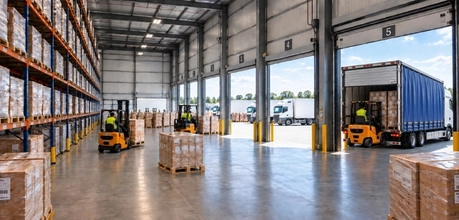
A pick and pack warehouse is a facility purpose-built (or adapted) to store inventory and run this retrieval and despatch process efficiently. Unlike a general storage warehouse, a pick and pack warehouse is organised around pick paths, SKU zoning, and despatch flow rather than pure storage density.
Most Australian 3PL providers lay out their pick and pack warehouse with fast-moving stock closest to despatch, bulk inventory further back, and clearly labelled bin locations linked to the WMS. The best pick and pack warehouse operations also build in space for kitting, bundling, returns processing and seasonal overflow, because ecommerce demand rarely stays flat across the year.
How to Pick and Pack Process Works
The pick and pack process runs as a repeatable sequence. Every step is a control point, and every skipped control point becomes an error somewhere downstream.
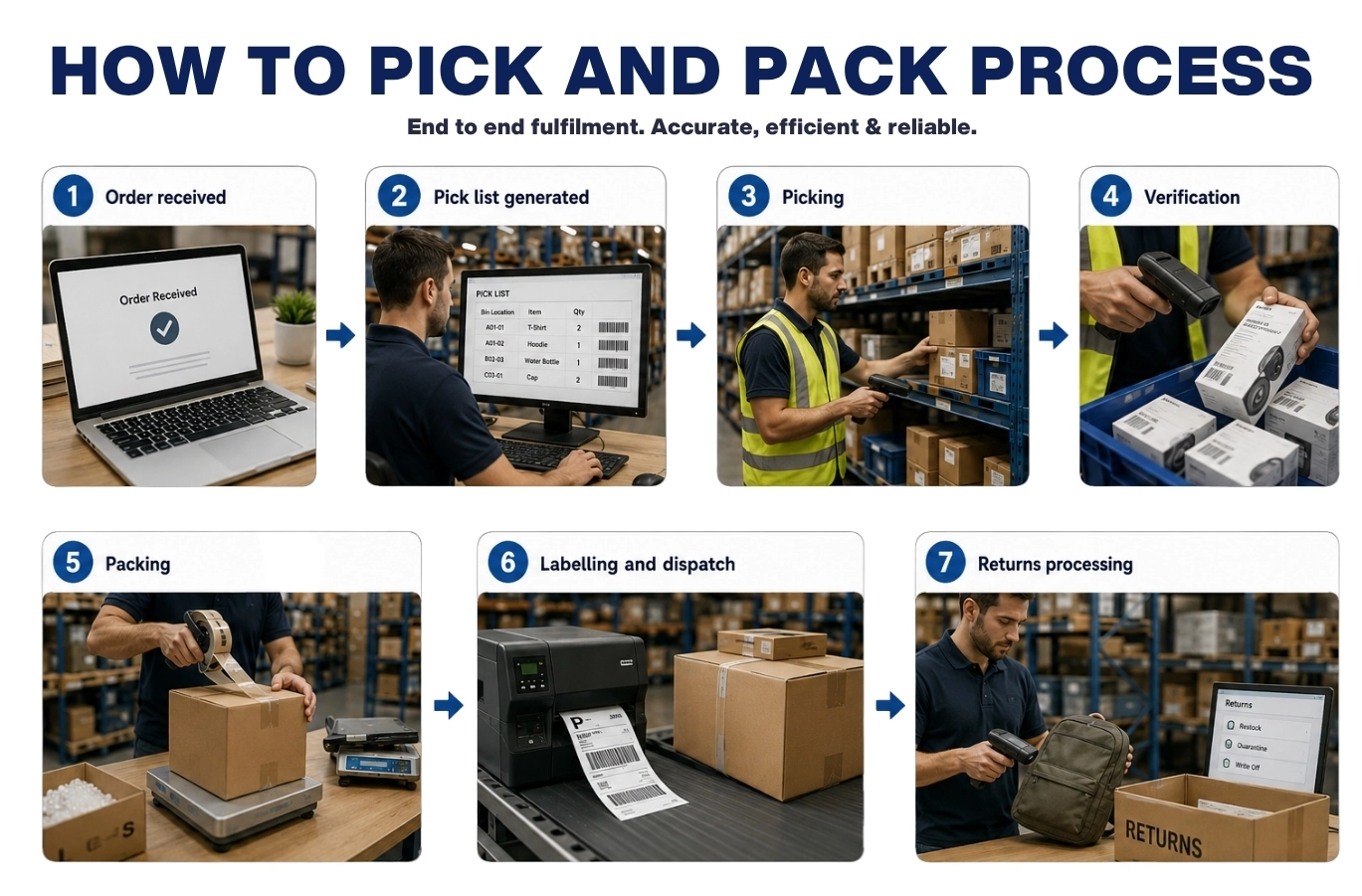
1. Order received
An order is placed on E-commerce fulfilment and flows into the warehouse management system through an API or middleware connection. Address validation and payment clearance happen here, before any labour is spent.
2. Pick list generated
The WMS converts the order into a pick list sequenced by bin location, not by the order the customer added items to their cart. Good sequencing alone can cut walking distance by 30% or more.
3. Picking
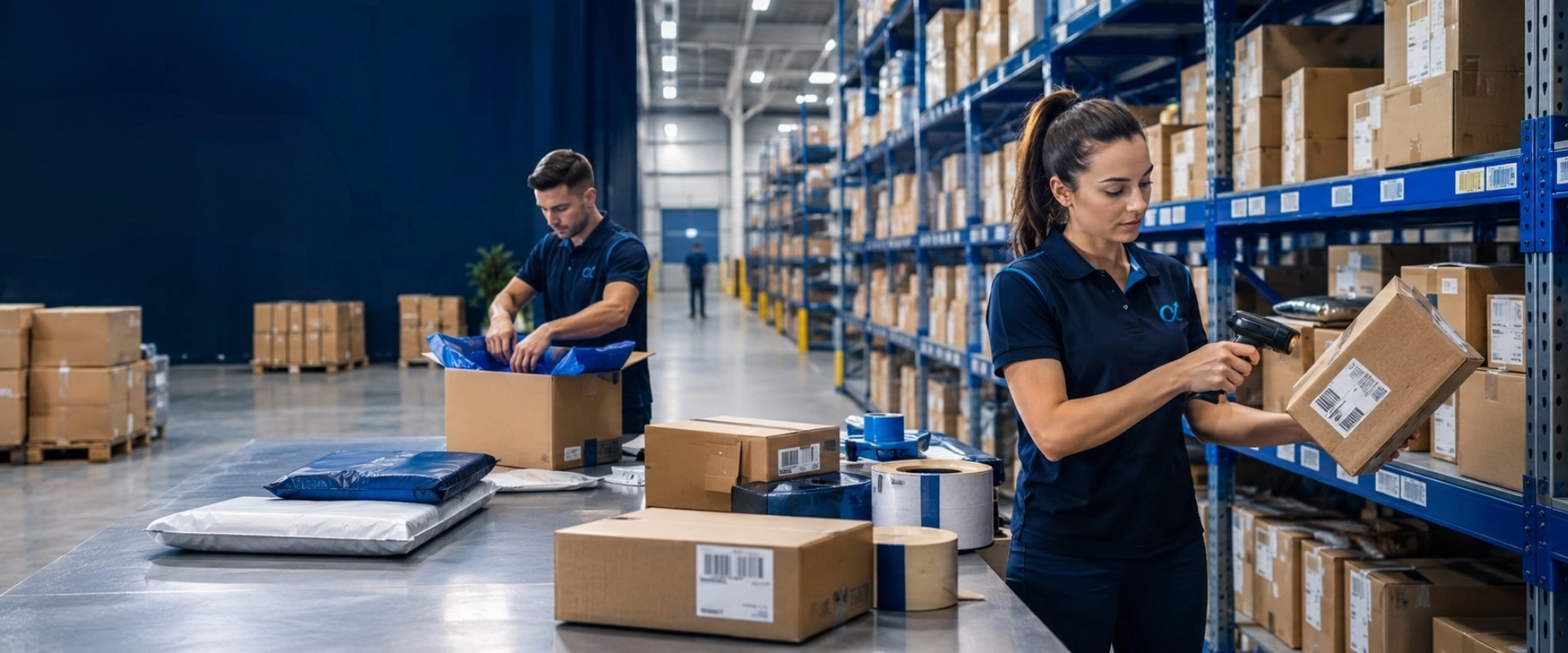
The picker walks the route and scans each item against its bin location. Scan verification is the difference between a warehouse that catches errors and one that ships them.
4. Verification
Items are verified against the order quantity, variant, size, colour, expiry or batch where relevant. In a well-run operation this is a scan, not a visual guess.
5. Packing
The order is packed into the suitable pallet or skid, protected with appropriate fill, and weighed and dimensioned. Cartonisation matters because commercial carriers rate on cubic weight, so an oversized box is a permanent freight surcharge you pay on every order.
6. Labelling and dispatch
A carrier label and consignment note are generated, tracking is pushed back to the customer, and the parcel is marshalled into the correct carrier lane ahead of cut-off. Once manifested, the parcel becomes a freight problem rather than a warehouse one.
7. Returns processing
Returns are received, inspected, and either restocked, quarantined or written off. Treating returns as an afterthought is one of the fastest ways to corrupt inventory accuracy, which then corrupts everything upstream.
What Are the Main Pick and Pack Methods?
There are four core picking methods, plus a hybrid that suits small-item retailers. The most common and most expensive mistake in Australian warehouses is a method-volume mismatch: running piece picking at 800 orders a day, or running wave picking at 60 orders a day where no coordination is actually needed.
|
Method |
How It Works |
Best Suited To |
Main Trade-off |
|
Piece (discrete) picking |
One picker completes one order at a time, start to finish. |
Under ~50 orders/day, low SKU count |
Simple and accurate, but travel time per order is the highest of any method. |
|
Batch picking |
One picker collects the same SKU across multiple orders in a single trip, then sorts. |
50–200 orders/day with overlapping SKUs |
Big travel savings, but sorting errors rise without scan verification. |
|
Zone picking |
The warehouse is split into zones; each picker works only their zone and passes orders on. |
500+ orders/day, large floor area |
Minimal travel, but handoffs add complexity and can create bottlenecks. |
|
Wave picking |
Batches are released across zones at scheduled times aligned to carrier cut-offs. |
High-volume, multi-channel, multi-carrier |
Most efficient at scale - but it amplifies every error when planning is poor. |
|
Pick-to-carton |
Items are picked directly into the final shipping carton, skipping a separate pack step. |
Small, light, uniform items (beauty, accessories) |
Removes a whole handling stage, but only works with predictable cartonisation. |
Pick and Pack Warehouse Strategies
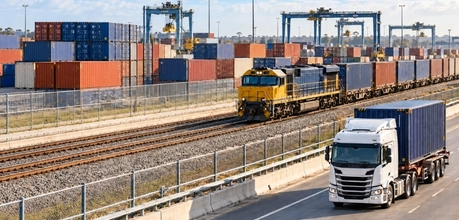
Bulk cargo transportation in Australia moves across four core modes, often in combination:
Choosing a method is only half the job. The strategies below are what separate a warehouse pick and pack operation that scales from one that seizes up every November.
i. ABC slotting
Rank SKUs by pick frequency and place the fastest movers closest to the packing benches at waist height. In most Australian ecommerce catalogues, around 20% of SKUs drive 80% of picks, so slotting is the cheapest performance upgrade available. It costs a weekend, not a capital budget.
ii. Zone design around product profile
Group bulky, fragile, cold-chain and high-value stock into their own zones with handling rules attached. Mixing a 15kg carton and a glass bottle on the same pick route invites damage claims.
iii. Batch sizing around carrier cut-offs
Work backwards from the last carrier collection of the day. Batch and wave sizes should be set so the final wave clears packing at least 45 minutes before the truck arrives, not as it pulls in.
iv. Seasonal surge planning
Black Friday, Click Frenzy and EOFY compress a month of volume into days. Plan surge capacity in advance pre-slot promotional SKUs, pre-kit bundles, pre-print labels, and book freight capacity early rather than competing for it on the day.
v. Hybrid in-house and outsourced models
Many scaling brands keep custom, fragile or personalised SKUs in-house and push standard, high-volume lines to a 3PL. It is not an all-or-nothing decision, and treating it as one delays the move for years.
Benefits of Pick and Pack Fulfilment for Ecommerce Sellers
- Lower operating costs - no need to lease, staff and run your own warehouse.
- Higher accuracy - scan-verified pick and pack fulfilment routinely achieves accuracy above 99%.
- Faster despatch - same day cut-offs keep delivery windows short and predictable.
- Seasonal scalability - throughput can flex up for sales events without hiring in-house staff.
- Stronger customer retention - accurate, on-time fulfilment increases repeat purchase rates by up to 30%, according to Australia Post research.
- More time for growth - founders can focus on product and marketing instead of warehouse logistics

Common Pick and Pack Errors and How to Prevent Them
Across the industry, roughly 1-3 errors per 100 orders is typical, and more than a third of warehouses report picking error rates above 1%. On 200,000 orders a year, the gap between 97% and 99.5% accuracy is around 5,000 wrong parcels every one of which costs a re-pick, a return freight leg and a customer.
|
Error |
Root Cause |
Prevention |
|
Wrong item picked |
Similar SKUs stored side by side; visual-only picking |
Barcode scan verification at pick; separate look-alike SKUs across bins |
|
Wrong quantity |
Manual counting of multi-unit lines |
Force quantity confirmation in the WMS; use weight-check scales at pack |
|
Wrong variant (size/colour) |
Parent SKU picked instead of child variant |
Variant-level barcodes on every unit, no exceptions |
|
Damaged in transit |
Oversized carton, insufficient void fill |
Cartonisation rules by SKU; documented packing standards per product class |
|
Missing insert or paperwork |
Manual, memory-based packing steps |
System-prompted packing checklists at the bench |
|
Late dispatch |
Waves finishing after carrier cut-off |
Work backwards from cut-off; monitor an on-time dispatch KPI daily |
|
Phantom stock |
Returns and damages not written back correctly |
Cycle counting weekly; segregated returns processing area |
KPIs to Measure Pick and Pack Performance
If you outsource warehouse picking and packing, these are the numbers to write into the agreement. If you run it in-house, these are the numbers to put on the wall.
|
KPI |
What It Measures |
Healthy Benchmark |
|
Order accuracy rate |
Orders shipped with zero errors |
99.5%+ (industry average 97–99%) |
|
On-time dispatch rate |
Orders manifested before carrier cut-off |
98%+ |
|
Picks per hour |
Labour productivity per picker |
Varies by method; track the trend, not the number |
|
Cost per order |
Total fulfilment cost ÷ orders shipped |
Falls as volume grows — if it doesn't, something is broken |
|
Inventory accuracy |
System stock versus counted stock |
99%+ on cycle counts |
|
Order cycle time |
Order placed to parcel manifested |
Under 24 hours for standard ecommerce |
|
Return rate (fulfilment-caused) |
Returns due to warehouse error, not customer choice |
Under 0.5% of orders |
|
Perfect order rate |
Right item, right time, undamaged, correct paperwork |
95%+ |
How Can Businesses Improve Pick and Pack Efficiency?
- Optimise warehouse layout around fast-moving SKUs.
- Invest in a WMS that integrates directly with your storefront.
- Introduce barcode or RFID scanning at every handover point.
- Train staff on packing standards, not just speed targets.
- Right-size packaging to control dimensional weight and freight cost.
- Review batch and wave picking schedules against real order patterns each quarter.
How Does Technology Improve Pick and Pack Fulfilment?
1. Warehouse management systems (WMS)
The WMS is the backbone. It sequences pick paths, enforces scan verification, tracks bin-level stock and produces the reporting that KPIs depend on. Without one, everything else is decoration.
2. Barcode and RFID scanning
Scan verification at pick and again at pack is the highest-return technology investment in fulfilment. It converts human attention into a system check.
3. Pick-to-light and voice picking
Light directed and voice directed picking free the picker's hands and eyes, lifting rates significantly in dense, fast-moving zones. They earn their cost in high-volume operations, not small ones.
4. Ecommerce and carrier integrations
Ecommerce and carrier platforms remove manual data entry which removes the address errors, missed orders and duplicate consignments that manual entry creates.
5. Automation and robotics
Conveyors, automated cartonisers, put walls and autonomous mobile robots are increasingly viable in larger Australian facilities. The realistic entry point for most mid-sized operations is partial automation at the packing bench, not a fully automated warehouse.
6. Data and forecasting
Demand forecasting drives labour rostering and slotting decisions. The operations that cope best with peak are the ones that saw it coming three weeks out.
When Should a Business Outsource Pick and Pack Services?
There is a fairly reliable crossover point. For most ecommerce brands, outsourcing becomes cost-competitive somewhere around 500 to 1,000 orders per month. Below that, in-house is usually cheaper and gives you tighter control.
Clear signals it is time to outsource:
- You are packing after hours or on weekends to keep up.
- Peak season forces you to hire and train casuals you cannot retain.
- Your warehouse lease is the constraint on growth, not demand.
- Error rates climb whenever volume climbs.
- You want stock closer to customers in multiple states to cut delivery times.
- Fulfilment is consuming management attention that belongs on product and marketing.
Reasons to keep it in-house:
- Highly customised, personalised or hand-finished orders.
- Regulated, dangerous goods with restrictive handling requirements.
- Very low volumes where a 3PL's minimum monthly charge exceeds your actual cost.
- Unboxing experience is a core part of the brand and cannot yet be replicated externally.
How to Choose the Right Pick and Pack Fulfilment Partner in Australia
Australia's geography makes this decision different from the UK or US. Distances between capital cities are long, regional delivery is expensive, and a single Sydney facility does not automatically serve Perth well. Use the checklist below.
|
What to Check |
Why It Matters |
Question to Ask |
|
Warehouse location and network |
Determines delivery time and cost to your customer base |
"Where are your facilities, and where do most of my orders go?" |
|
Platform integrations |
Manual order entry is the biggest source of avoidable errors |
"Do you integrate natively with my store, or through middleware?" |
|
Accuracy and dispatch SLAs |
Without a contracted number, there is nothing to hold anyone to |
"What accuracy and on-time dispatch rates do you guarantee?" |
|
Pricing transparency |
Bundled pricing hides receiving, storage and surcharge costs |
"Can I see a full cost-per-order breakdown including receiving and storage?" |
|
Carrier neutrality |
Locked-in carriers remove leverage and resilience |
"Can I use my own freight accounts or your negotiated rates?" |
|
Scalability and peak capacity |
Peak is when a weak partner fails |
"What did your dispatch performance look like last Black Friday?" |
|
Returns handling |
Returns quietly destroy inventory accuracy |
"How are returns inspected, restocked and reported?" |
|
Insurance and compliance |
Protects your stock while it sits in someone else's building |
"What cover applies to my inventory on your site?" |
Why Choose Alpha Trucking for 3PL Pick and Pack Solutions?
Alpha Trucking is an Australian road freight and logistics operator working with ecommerce sellers, wholesalers and manufacturers nationally. Our 3PL Warehousing services help businesses streamline fulfilment, warehousing and freight operations, with a strong focus on what happens when goods leave the warehouse and need to reach customers on time, intact and at a predictable cost.
- Nationwide reach. Metro and regional delivery across New South Wales, Victoria, Queensland, South Australia, Western Australia and beyond, with linehaul connections between capitals.
- Parcel, skid and pallet capability. One provider whether you are shipping a 400g satchel or a full pallet of stock into a 3PL.
- Dispatch-aligned collections. Pickup schedules built around your packing cut-offs, not ours.
- Tracked consignments. Visibility from collection through to proof of delivery.
- Real people on the phone. When a consignment needs intervention, you speak to someone who can act on it.
Conclusion: Is Pick and Pack Fulfilment Right for Your Business?
If you're shipping more than a handful of orders a week, pick and pack fulfilment isn't optional. It's the process that decides whether your customers get the right item, on time, in one piece. As Australian online spend keeps climbing past $82 billion a year, sellers who invest in accurate picking, smart packing and a reliable freight partner are the ones who turn first-time buyers into repeat customers.