
Quick Update
Victoria has set out a ten-year direction for rail freight covering 2026 to 2036, and the reaction from parts of the road transport industry has been predictable: if more freight moves by rail, does that mean less work for trucks? The honest answer is no, but it does mean the work changes shape. Mode shift does not remove the road task. It relocates it.
Why Victoria Needs a Ten-Year Rail Plan
Victoria carries a freight problem that is structural rather than political. The Port of Melbourne handles the largest container volume of any Australian port, and most of those containers currently move to and from the port by road. Every one of those movements competes for space on an inner-west road network that is already congested, already noise-constrained, and already the subject of long-running community pressure over truck movements through residential suburbs.
A decade-scale plan exists because the alternatives are finite. You cannot widen your way out of a container task that grows with the population, and the land needed for additional road capacity near the port either does not exist or costs more than rail infrastructure would. Rail becomes the pressure valve, not because it is ideologically preferred, but because the arithmetic of port growth leaves few other options.
The Regional Gauge Problem
The state also carries a complicated rail inheritance. Regional Victoria runs a mix of broad gauge and standard gauge track, a legacy that still constrains how freight moves between farm, silo and port. Grain, mineral sands, timber and containerised agricultural exports all sit on networks where the gauge, the axle load rating and the condition of the line determine what can realistically be hauled. Any serious plan has to address the regional network as well as the metropolitan one, or the port improvements simply shift the bottleneck inland.
Rail Does Not Deliver to a Loading Dock
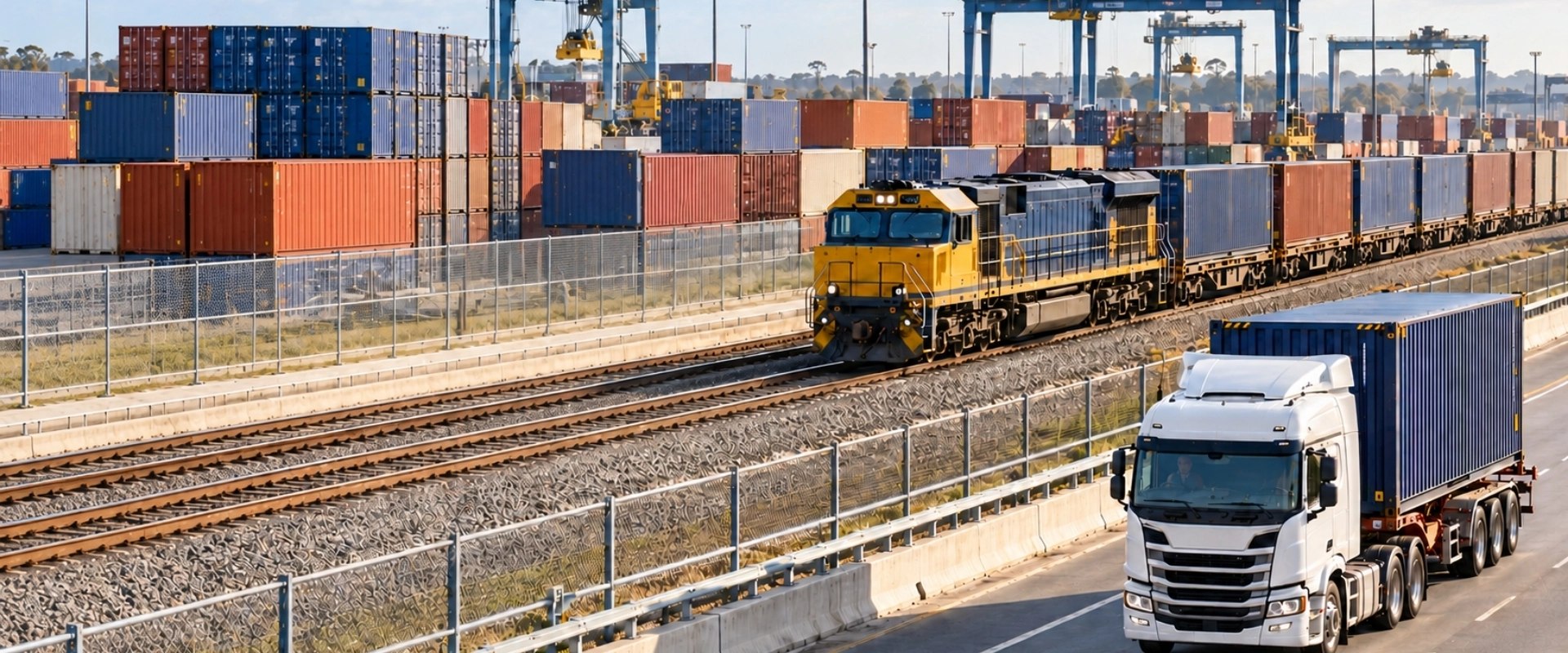
Here is the part that matters most for road operators. Rail does not deliver to a loading dock. Every container that arrives at an intermodal terminal still needs a truck to complete the journey, and the growth of terminal capacity is, in practice, the growth of a drayage task. The interstate terminals at Beveridge and Truganina, and the port rail shuttle concept more broadly, are designed to concentrate freight at inland nodes and move it in bulk on rail. What happens in the final 20 or 40 kilometers remains a road movement?
So, the question for an operator is not whether rail takes volume. It is whether your fleet is positioned near the nodes where that volume lands.
What Changes for Road Fleets?
That positioning question has real consequences. Depot location becomes more important than it was when every container ran from the port itself. Shuttle timetables introduce fixed windows that road schedules must meet, which rewards operators who can turn trucks quickly and penalises those who cannot. Terminal access arrangements, booking systems and queueing performance start to matter as much as line-haul efficiency. And the trip profile shifts from long single legs to shorter, higher-frequency runs, which changes vehicle selection, driver rostering and fatigue planning.
There is a commercial opportunity for operators who read it early. Customers increasingly want a single party to manage the whole chain rather than coordinating separate providers, and businesses offering integrated Victoria freight transport alongside structured freight transport solutions are better placed than those selling line haul alone. Operators such as Alpha Trucking approach intermodal change as a planning input, working alongside rail freight services rather than treating them as competition for the same load.
Regional operators face a different version of the same question. If grain or mineral sands volumes move to rail at an upgraded loading point, the road task consolidates around feeding that point rather than running the full distance to port. That is shorter work, but it is also steadier work, and it is work that goes to whoever is already established in the catchment.
Planning Around Policy, Not Reacting to It
Reading infrastructure and policy direction early is the same discipline that applies to fuel supply, route changes and compliance. Our earlier update on the fuel security emergency powers coming to Western Australia covers that principle applied to a very different kind of disruption.
The Takeaway
Nothing in a ten-year plan happens quickly. Rail infrastructure runs timelines measured in election cycles, and the gap between a published strategy and a commissioned siding is usually long enough for several operators to change hands. Treating the plan as an immediate threat would be an overreaction.
Treating it as irrelevant would be the bigger mistake. The direction of travel in Victorian freight is clear enough: more containers through inland terminals, more scheduled rail movements, and a road task that becomes shorter, denser and more tightly timed. Operators who understand where the terminals will sit, and who build the depot footprint and scheduling discipline to serve them, will find the next decade considerably easier than those who wait to see how it plays out.