

Quick Update
A $45.1 million package of safety upgrades is being rolled out across 82 identified black spot locations in New South Wales, targeting intersections and stretches of road with a documented history of serious crashes. For the freight industry, the announcement carries a double message. The network that heavy vehicles run every day is being made measurably safer, and a wave of construction activity is about to land on some of the state's busiest routes.
Where the Money Actually Goes
Black spot funding is not spread evenly the way general road maintenance is. It is directed at specific sites chosen on crash history and risk assessment, which is why 82 locations can absorb $45.1 million while thousands of kilometres of road elsewhere see nothing in the same round. Typical treatments at these sites include intersection redesigns and dedicated turning lanes, upgraded signage and line marking, improved street lighting, safety barriers and guardrails, wider sealed shoulders, and better curve delineation on rural roads.
Individually these are modest works. Collectively, black spot programs carry some of the strongest cost-benefit numbers in road safety, because they fix the exact locations where crashes are already concentrated instead of treating the whole network at once.
Why Heavy Vehicle Operators Should Pay Attention
For a passenger car, a poorly designed intersection is an inconvenience. For a heavy combination running at gross mass, it can be the difference between a clean turn and a rollover. Trucks carry longer stopping distances, wider swept paths and higher centers of gravity, so the very defects black spot funding tends to address are the ones that punish heavy vehicles hardest: tight turning radii, restricted sight lines, soft or unsealed shoulders, and unprotected rural curves.
There is also a severity factor. When a heavy vehicle is involved in a crash, the outcome is more often fatal or serious, so infrastructure improvements at high-risk sites deliver a disproportionate benefit to the freight task even where trucks make up a small share of the traffic count.
Short-Term Disruption, Long-Term Gain
The other side of the announcement is roadworks. Eighty-two active or upcoming work sites across the state means reduced speed zones, lane closures, temporary traffic control, and in some cases width or access restrictions while construction is underway. Operators running tight schedules are better off building these into route planning now rather than discovering them at 2am on a linehaul run.
A few practical steps are worth taking. Transport for NSW project pages for the corridors your fleet uses most and check them again close to departure. Brief drivers on changed conditions at known sites, particularly where a familiar intersection layout is being altered mid-project. Build buffer time into schedules on affected routes and make sure that buffer does not quietly come out of a driver's rest break, because fatigue obligations under the Heavy Vehicle National Law do not bend for a work zone. If a delay is unavoidable, tell the customer earlier than late.
More Work Zones Usually Means More Enforcement
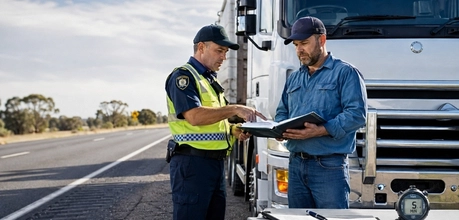
Work zones also tend to attract a heavier enforcement presence, which makes it a good moment for drivers to be clear on their roadside rights. If a compliance stop runs five minutes or longer, a driver of a fatigue-regulated heavy vehicle can ask the authorized officer to record the officer's details, the details of the stop and the time spent, directly in the work diary. Our earlier update on HVNL Section 582 and work diary entries during roadside stops covers exactly how to make that request.
Planning Around the Works
Safety upgrades and scheduling discipline are two halves of the same problem. Operators such as Alpha Trucking treat road network changes as a planning input rather than a surprise, which matters most for customers relying on time-sensitive Freight forwarding services and structured Cargo transport solutions, where a single unexpected 40-minute detour can push a delivery outside its booked window and unwind a full day's run.
The Takeaway
The longer-term picture is the more encouraging one. Every guardrail installed on a rural curve, every intersection given a proper right-turn lane, and every dark rural junction fitted with lighting removes a small piece of risk from the same roads the freight task depends on. Black spot works are unglamorous, but they are precisely the kind of intervention that reduces the crashes drivers never end up having.
For fleets, the sensible response to a $45.1 million upgrade program is not to wait for it to finish. It is to map which of the 82 sites sit on your regular routes, plan around the construction phase, keep records tight while enforcement activity is elevated, and treat the finished works as a genuine improvement to the operating environment rather than just another line item in a government announcemen