
Quick Summary
LTL consolidation combines several less-than-truckload shipments from one business or from multiple suppliers into a single full trailer that runs one linehaul leg, then splits back out at a regional hub for final delivery. For Australian B2B shippers moving freight across the Melbourne, Sydney, Brisbane triangle or the east - west corridor, it usually reduces freight spend by 15-30%, lowers damage claims by cutting terminal touchpoints, and trades one to two days of transit flexibility for a materially lower cost per cubic metre. It suits palletised, non-urgent, regularly scheduled freight. It is a poor fit for single urgent pallets, temperature-sensitive goods and genuine one-off consignments.
Introduction
Australia moves an enormous amount of freight for a country with a small population. The Bureau of Infrastructure and Transport Research Economics puts the national domestic freight task at roughly 800 billion tonne-kilometres a year, and forecasts it will grow by around 26% by 2050 (BITRE, Australian Aggregate Freight Forecasts). Almost all of that growth funnels through the same handful of corridors the Hume, the Pacific, the Newell and the transcontinental run to Perth.
For a business shipping three pallets at a time, that congestion shows up on the invoice. Part-loads are the most expensive freight in Australia per cubic metre, because someone still has to pay for the empty space around them. That is the pressure that has pushed LTL consolidation from a nice to a core cost lever for Australian manufacturers, wholesalers, importers and e-commerce operators.
This guide explains what it is, how the mechanics actually work, and what it costs under Australian cubic pricing rule.
What Is LTL Consolidation?
LTL consolidation is the practice of combining multiple less than truckload consignments into one full trailer for the long-haul portion of a journey, then breaking that trailer back down at a destination hub so each consignment completes its own final-mile delivery.
LTL freight consolidation generally takes one of three forms in the Australian market:
- Single-shipper consolidation: one business combines several of its own orders, often across a few days, into one departure. Common for wholesalers supplying multiple stockists in the same state.
- Multi-shipper consolidation: a carrier groups freight from unrelated customers heading to the same region. This is the standard model behind scheduled interstate services.
- Multi-vendor inbound consolidation: a buyer has several suppliers delivered into one depot, where the goods are combined and forwarded as one inbound receipt. Widely used by retailers and manufacturers pulling stock from multiple sources.
How Does LTL Consolidation Work?
Understanding how LTL consolidation process follows a consignment through the network. The process runs in six stages.
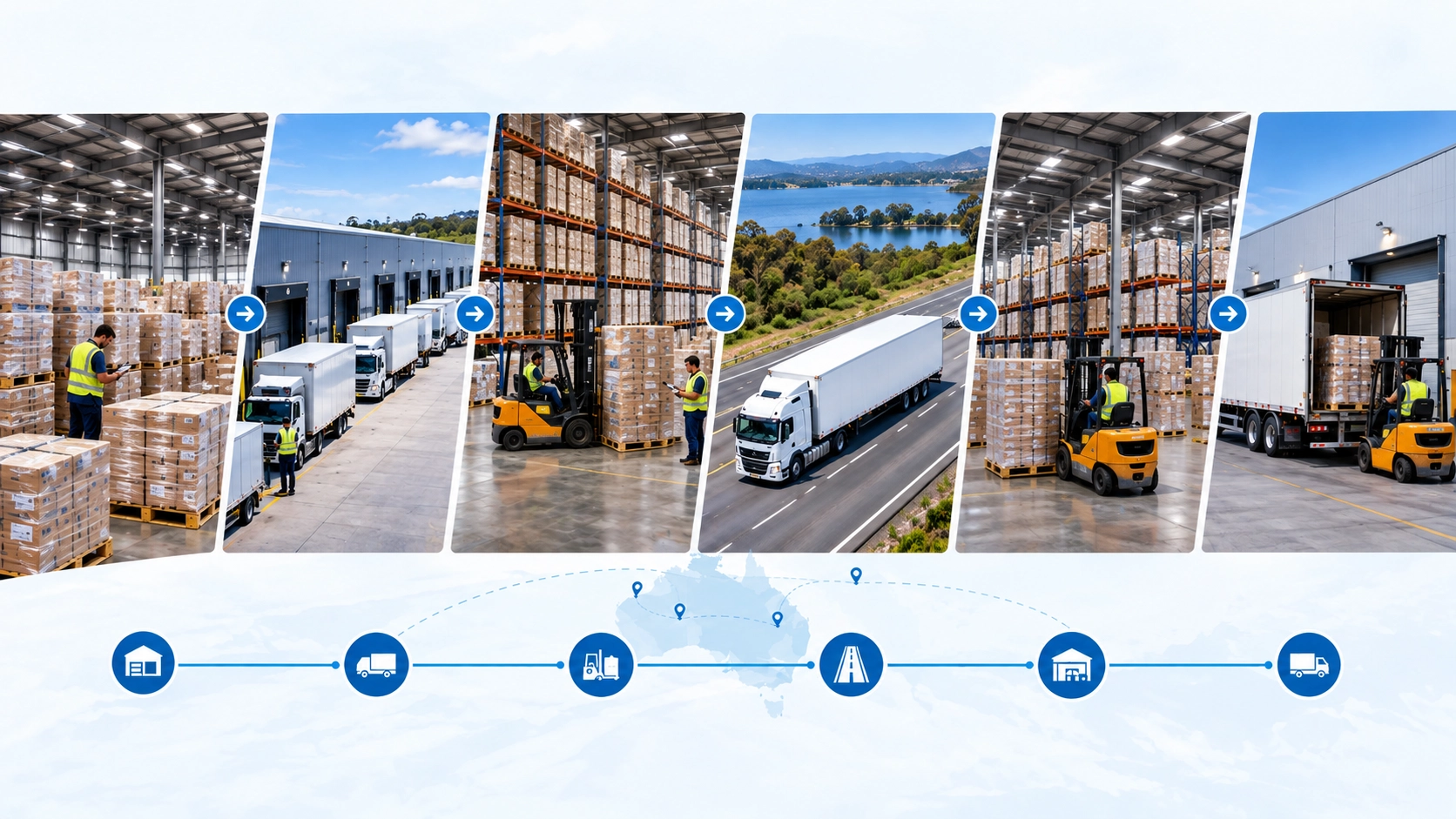
1. Booking and cut-off
Each lane runs to a departure schedule with a cut-off time for example, freight into the Melbourne consolidation must be on the dock by 14:00 Wednesday for a Wednesday night line haul. Consignments are booked against a departure, not simply collected on demand.
2. Pick-up and inbound
Local rigids and tautliners collect freight around the metro area and return it to the depot. Because several collections feed one line-haul, the pick-up cost is spread across many consignments rather than carried by one.
3. Consolidation and load build
This is where the value is created. Freight is measured, weighed, checked against the manifest, and built into a load plan. A good load planner considers weight distribution across axles, stackability, delivery sequence at the far end, and dangerous goods segregation. Freight that can be double stacked goes together. Fragile or non-stackable items get top deck positions.
4. Line-haul
The consolidated load runs to the destination city as one movement, usually overnight on the eastern seaboard and over several days on the longer transcontinental legs. This single leg is where the cost per kilogram drops, because the fixed costs of the vehicle, driver and fuel are shared across a far greater volume of freight.
5. Deconsolidation
At the destination depot the load is broken down and sorted by delivery run. Consignments are scanned, checked and allocated to local vehicles. Any discrepancies should be identified here rather than at the customer's door.
6. Final delivery
Local delivery runs complete the movement. Where several consignments are going to the same receiver, they can be delivered together one arrival, one signature, one receiving process.
LTL Consolidation vs Standard LTL Shipping
Both models put your freight on a shared vehicle. The difference is whether the loading is deliberate and scheduled, or opportunistic.
|
Factor |
Standard LTL |
Consolidated LTL |
|
Movement |
Freight joins an existing mixed line-haul, hub to hub |
Freight is pooled into a purpose-built trailer for one lane |
|
Handling points |
Typically 4-6 touchpoints across multiple terminals |
Typically 2-3 touchpoints. origin hub and destination hub |
|
Transit time |
Faster and more flexible; daily departures |
Slower and schedule-bound, fixed weekly or biweekly departures |
|
Pricing basis |
Cubic conversion plus per-consignment minimums and terminal fees |
Shared linehaul cost spread across the load, lower effective rate per m³ |
|
Damage exposure |
Higher each terminal cross-dock is a handling risk |
Lower - fewer transfers, freight stays loaded through linehaul |
|
Admin load |
Multiple consignments, multiple charges |
Fewer bookings, consolidated invoicing |
|
Best suited to |
Urgent, irregular or single-pallet freight |
Predictable, repeatable, non-urgent palletised volume |
What Are the Benefits of LTL Consolidation for B2B Shippers?

1. Lower cost per unit shipped
This is the headline benefit and the easiest to measure. Minimum charges, pick-up fees and fuel levies apply per consignment. Combine six consignments into one and you pay those overheads once rather than six times. On light freight with a poor weight-to-cubic ratio, the saving is often the largest single line item improvement available to a shipper.
2. Fewer touch points, less damage
Transit damage correlates closely with handling events. Freight that stays built as one unit through line-haul is picked up, put down and re-sorted far fewer times than the same goods moving as separate consignments. Fewer claims, fewer credits, fewer replacement dispatches.
3. Cleaner receiving at the far end
Receiving docks measure their day in arrivals, not kilograms. A customer taking one consolidated delivery instead of five separate ones spends less time booking dock slots, checking paperwork and chasing missing items. For businesses supplying DCs with strict delivery windows, this alone can be decisive.
4. Better inventory rhythm
A scheduled consolidation creates a predictable replenishment cadence. Knowing that freight departs Sydney every Tuesday and Friday lets purchasing and warehouse teams plan around it, rather than reacting to ad hoc despatches.
5. Lower emissions per tonne moved
A well-utilised trailer moves more freight for the same fuel burn. For businesses reporting on scope 3 emissions or responding to customer sustainability questionnaires, the benefits of LTL consolidation are straightforward to demonstrate: fewer vehicle movements for the same volume of goods.
6. Simpler administration
Fewer consignment notes, fewer invoice lines, fewer PODs to chase. Finance teams reconciling freight spend across dozens of small movements will feel this immediately.
What Types of Freight Can Be Consolidated?
Freight consolidation works best when goods are stable, stackable and unhurried.
Well suited:
- Palletised dry goods and shrink-wrapped cartons
- Retail and wholesale replenishment stock
- Building products, fixtures, fittings and hardware
- Packaged FMCG and shelf-stable consumables
- Spare parts, componentry and industrial supplies
- Apparel, homewares and general merchandise
- Flat-packed furniture and boxed white goods
Poorly suited or excluded:
- Dangerous goods requiring segregation under the Australian Dangerous Goods (ADG) Code possible with specialist providers, but not on general pool loads
- Temperature-controlled, chilled or frozen product without a dedicated cold-chain service
- Oversize, overheight or non-stackable freight that blocks trailer cubing
- High-value or security-sensitive goods where chain of custody must stay narrow
- Unstable or poorly packaged loads that cannot bear a second tier
How Is Freight Consolidation Priced in Australia?
This is where Australian shippers get caught out, because our market prices road freight differently to the United States. Freight consolidation here is priced primarily on cubic conversion, not on freight class.
Cubic conversion explained
Most Australian road carriers apply a conversion factor of 250 kg per cubic metre, though some use 333 kg per m³ always confirm which applies to your rate card. Your chargeable weight is the greater of actual weight or cubic weight.
Worked example:
- 4 standard Australian pallets at 1.2 m × 1.2 m × 1.4 m = 2.016 m³ each
- Total volume = 8.06 m³
- Cubic weight at 250 kg/m³ = 2,016 kg
- If actual weight is 1,400 kg, you are billed on 2,016 kg
Understanding this changes behaviour. Reducing pallet height from 1.4 m to 1.2 m on that same shipment removes roughly 288 kg of chargeable weight without touching a single carton.
What else appears on a consolidated freight invoice
- Lane linehaul rate: The shared cost of the long leg
- Pickup and delivery zone charges: Metro, regional or remote
- Fuel levy: A percentage adjusted monthly against diesel benchmarks
- Hub handling fee: Per pallet or per consignment, covering consolidation and deconsolidation
- Ancillaries: Tail-lift, hand unload, futile pickup, redelivery, and remote area surcharges
When Should a Business Use LTL Consolidation?
LTL consolidation earns its place when most of the following are true:
- You regularly ship part loads anywhere from one pallet to roughly half a trailer rather than full vehicles.
- Your freight moves on repeat lanes, particularly the high-volume interstate corridors between the eastern seaboard capitals, or into Adelaide and Perth.
- Your delivery dates have some flexibility, so freight can wait a day for a scheduled departure without breaking a promise to a customer.
- You are shipping to the same regions repeatedly, so freight naturally groups by destination.
- Minimum charges make up a visible share of your freight spend, check your last three invoices.
- Your receivers prefer fewer, larger deliveries, especially DCs with booked dock slots.
- You buy from several suppliers in one city and could have them deliver into a single consolidation point.
When Is LTL Consolidation Not the Best Option?
Recommending it universally would be dishonest. It is genuinely the wrong call in these situations:
- Time-critical freight: If the delivery window is measured in hours, use express or dedicated transport.
- Perishables and pharmaceuticals: Cold-chain integrity and temperature excursion risk outweigh the savings.
- Single ad hoc pallets: A one-off consignment with no lane pattern gains nothing from a scheduled service.
- Volume that already justifies FTL: Once you are consistently at 18-22 pallets on a lane, direct full-truckload is faster and usually cheaper per unit.
- Short metro runs: Sydney CBD to Parramatta does not need a hub in the middle of it.
- High-value or fragile freight: Where shared-load handling risk is unacceptable, buy dedicated capacity.
What Are the Challenges of LTL Consolidation?
1. Transit time and schedule discipline
Freight waits for the departure window. Miss a cut-off and the consignment rolls to the next service, which on a twice-weekly lane can mean a three-day delay. Consolidation demands better internal dispatch discipline than ad hoc shipping does.
2. Visibility across the middle of the journey
Once freight is built into a consolidated load, tracking can become coarser as the load moves, not each carton. Insist on consignment-level scanning at build, line-haul departure, arrival and deconsolidation, not just at pick-up and delivery.
3. Mixed-freight compatibility
Freight travelling together must be genuinely compatible. Dangerous goods segregation, food-grade separation, weight distribution and stackability all constrain load building. A carrier that ignores this to fill a trailer is creating a claim, not a saving.
4. Damage concentrated at build and break points
Consolidation reduces total handling but concentrates risk at two moments. The load build and the deconsolidation. Both need to be done by people who know what they are doing, with condition checks recorded at each.
5. Chain of Responsibility obligations
Under the Heavy Vehicle National Law, consignors, packers and loaders share legal responsibility for safe loading, mass limits and load restraint not just the driver. Declaring weights accurately and packaging freight properly is a legal duty, not a courtesy. The NHVR's Chain of Responsibility guidance sets out where those duties sit, and any credible LTL freight consolidation provider will expect you to meet them.
6. Reconciliation complexity
One invoice covering many consignments is simpler in one sense and harder in another. Ask for a breakdown that lets you allocate cost back to individual orders or customers, or the savings become impossible to prove internally.
How to Choose an LTL Freight Consolidation Partner
The right partner is the one whose network already runs your lanes frequently. Work through this checklist before signing anything:
- Hub footprint. Do they operate their own facilities in Melbourne, Sydney, Brisbane, Adelaide and Perth, or are they subcontracting? Subcontracting is not disqualifying opacity.
- Departure frequency. Daily, three times weekly, or weekly? This single figure determines your real lead time.
- Cubic policy transparency. Ask directly: 250 or 333 kg per m³? How are part-pallets treated? How are overheight pallets assessed?
- Claims performance and insurance. Request their claims ratio. Confirm whether you need separate marine transit insurance in most cases under standard conditions of carriage, you will.
- Compliance posture. Evidence of NHVR compliance, documented CoR procedures and current fatigue management systems.
- Systems integration. API or TMS connectivity, consignment-level tracking, and DIFOT reporting you can actually act on.
- Relevant references. Ask for two customers in your industry shipping comparable lanes, and call them.
Wrapping Up
LTL consolidation is not a silver bullet, and it does not suit every business. What it does exceptionally well is convert unpredictable, expensive part-load spending into a planned, shared and considerably cheaper freight programme provided your freight is stable, your volumes are reasonably regular, and your customers can live with a scheduled arrival rather than an urgent one.