

If you have noticed your freight invoices creeping up recently, you are not imagining it. Global oil prices have surged sharply in early 2026, and that movement affects the fuel levy on your shipping bill. Here is what is happening, why it matters to your business, and what you can do about it.
Why Global Oil Prices Matter to Every Australian Business?
Most Australian businesses do not track the oil market. They track their margins. The connection between the two, however, is tighter than most people realise.
Brent Crude and WTI - The Two Benchmarks You Should Know
Two numbers drive most of the world's oil pricing decisions. Brent crude is the global standard, sourced from the North Sea and used to price oil flowing from Europe, Africa, and the Middle East. WTI (West Texas Intermediate) is the US domestic benchmark. As of early April 2026, Brent crude is trading above $109 per barrel, a gain of more than 44% in three months, driven by the escalating conflict involving Iran and the near-closure of the Strait of Hormuz.
How Oil Travels from the Barrel to Your Freight Invoice
The path from a barrel of crude to your shipping invoice has several steps: crude is extracted, shipped to a refinery, converted into diesel, priced at the terminal gate, and then pumped into the trucks that carry your goods. Each step passes the cost forward. When global oil prices rise sharply, every link in that chain feels it. This chain is especially critical for heavy haulage transportation, where high fuel consumption means global price spikes are felt almost immediately.
What Is a Fuel Levy and How Is It Calculated?
Think of the fuel levy as a variable-rate electricity bill. Just as your electricity retailer adjusts your bill when wholesale power prices move, your domestic freight service carrier adjusts the fuel levy when diesel prices move. It is not a margin grab, but a mechanism to keep freight pricing honest on both sides.
Fuel Levy Rates Explained in Plain Terms
Fuel levy rates in Australia are expressed as a percentage of the base freight charge. Most carriers calculate them using a published index, typically the Australian Institute of Petroleum (AIP) Terminal Gate Price for diesel, and apply a standard formula:
Fuel Levy % = ((Current Fuel Price - Base Fuel Price) ÷ Base Fuel Price) × Fuel Cost Share
When the diesel price exceeds the base price set in your freight agreement, the levy percentage increases accordingly.
The Link Between Oil and Gas Prices and Your Levy
The connection between oil and gas prices and your levy is direct. When global oil markets move, Australian diesel prices follow as refineries and wholesalers reprice at the terminal gate. The AIP Terminal Gate Price is updated daily, and carriers that index to it can adjust fuel levy rates weekly or fortnightly while keeping the surcharge in step with real market conditions rather than lagging estimates.
As of Q1 2026, some businesses working with a logistics company Brisbane have seen fuel levy rates climb from 28% to nearly 60% of the base freight rate in a single month.
Key Global Events Driving Oil Price Swings Right Now
Oil markets do not move in isolation. Geopolitical shocks, production decisions, and supply disruptions set the price that ultimately lands on your invoice.
Middle East Conflict and Strait of Hormuz Disruptions
Here is the thing: the Strait of Hormuz is one of the most critical choke points in global energy supply, connecting the Persian Gulf to the wider oil market. As of Q1 2026, the Iran conflict has led to the effective closure of the strait for many tankers, stranding a significant share of Middle East oil flows and pushing Brent crude above $109 per barrel.
WTI crude spiked above $112 per barrel on 3 April 2026, its highest level since June 2022, after no clear path to reopening the strait was signalled
OPEC+ Supply Decisions and Their Ripple Effect on Gas Prices in Australia
OPEC+ is the alliance of major oil-producing nations that coordinates production levels to influence global supply. When production is cut, supply tightens, and oil and gas prices rise. When output increases, prices ease, and that downstream shift moves the AIP diesel index, which in turn moves fuel levy rates across Australian freight networks.
J.P. Morgan's Global Commodities Strategy team currently projects Brent averaging around $60 per barrel for 2026 if supply surpluses build as expected, but flags the Hormuz disruption as the key upside risk to that forecast.
Head of Global Commodities Strategy Natasha Kaneva has noted that "oil surplus was visible in January data and is likely to persist," while also cautioning that further destabilisation in Iran could lead to significantly higher prices sustained over extended periods
How Rising or Falling Oil Prices Flow Through to Australian Freight
Do rising global oil prices always hurt Australian freight customers? Not always, but the two directions do not always move in sync, and understanding the lag helps you plan.
From Refinery Gate to the Diesel Pump
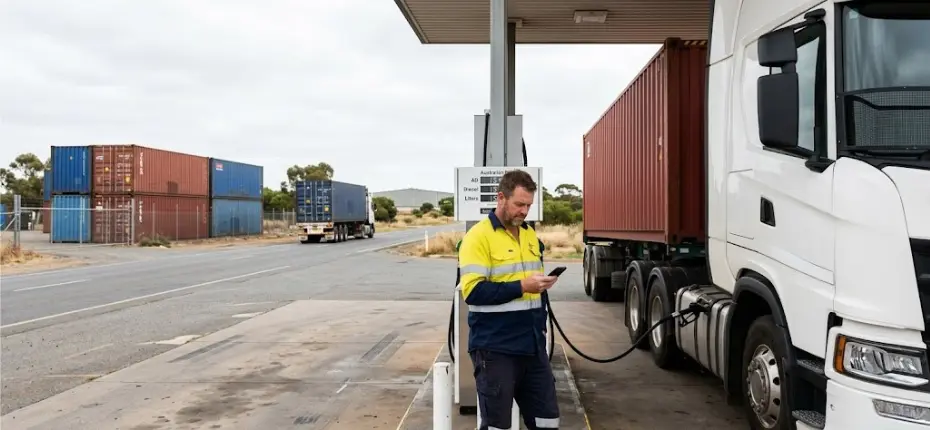
Australia's domestic refining capacity has declined significantly in recent years, increasing reliance on imported refined fuels, including diesel. This means global refinery margins, currency conversion, and terminal gate pricing all shape what carriers pay at the pump.
The short answer is: the AIP Terminal Gate Price updates daily, and carriers that use it as their levy index can move fuel levy rates weekly or fortnightly while keeping adjustments close to real market conditions. Speed matters. Fast, transparent adjustments protect both parties from absorbing unsustainable swings.
Why the Australian Dollar Adds Another Layer of Volatility?
Oil is priced in US dollars. Australian businesses pay in Australian dollars. That AUD/USD exchange rate is a second variable working alongside global oil prices, and it amplifies or dampens the impact depending on which way the dollar moves.
When the AUD weakens against the USD, Australian importers pay more for every barrel of crude, even if the USD oil price has not changed. Exchange rate movements and oil price movements can compound each other, and that dual volatility is worth understanding when you read a fuel levy adjustment notice.
How Alpha Trucking Keeps Your Shipping Costs Transparent
You should never open a freight invoice and find a surprise. Alpha Trucking's approach to fuel levy pricing is built around one principle: you see exactly what is driving the number, and when it changes, you know why.
Real-Time Fuel Levy Adjustments You Can Track
Alpha Trucking anchors its fuel levy rates to the published AIP Terminal Gate Price, the same data any business can access publicly. When diesel prices rise or fall, the levy adjusts on a set schedule, with advance notice. No black-box surcharges. No retrospective line items.
Locking in Rates - Options for Budget Certainty
Alpha Trucking offers fixed-rate freight options for businesses that need cost certainty over a defined period. These arrangements are particularly valuable during periods of extreme oil price volatility, such as Q1 2026, when spot-market levies can fluctuate significantly week to week. Get a freight quote from Alpha Trucking to explore which pricing structure suits your supply chain.
Frequently Asked Questions About Global Oil Prices and Fuel Levies
What is the global price of oil today?
Oil prices change daily. As of early April 2026, Brent crude futures are trading above $109 per barrel, driven by the closure of the Strait of Hormuz and supply disruptions in the Middle East.
For the current figure, check a live tracker such as the EIA website or Oilprice.com dashboard.
Is oil expected to go up or down?
Analyst consensus is split. The EIA's Short-Term Energy Outlook projects Brent could pull back below $80 per barrel in Q3 2026 if Middle East tensions ease and OPEC+ output increases, but forecasts remain highly sensitive to the conflict's duration.
Your Next Step to Managing Freight Fuel Costs
Global oil prices are volatile right now, and they directly affect every fuel levy on every freight invoice you receive. You cannot control Brent crude. But you can choose a freight partner that prices transparently and gives you options.
Get a freight quote from Alpha Trucking today, and know exactly what you are paying and why.