
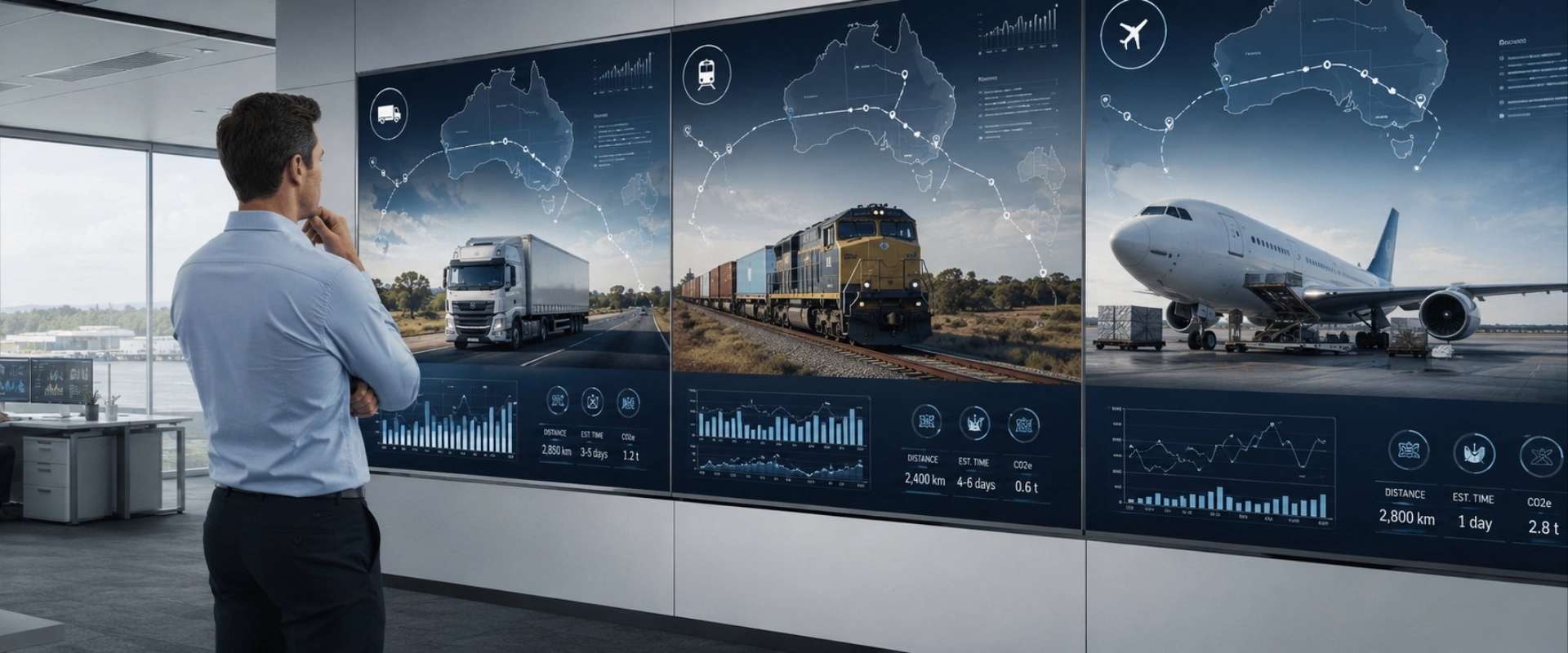
Domestic freight transport is the backbone of Australia’s supply chain. With vast distances between major cities, remote regional areas, and significant volumes of goods to move, choosing the best mode of freight transport Australia is not trivial. The wrong decision can mean extra cost, delays, or lost competitiveness.
At Alpha Trucking, we often hear from clients: should we send via road, rail, or air? In this article, we break down each mode—advantages, disadvantages, cost implications, and real-world use cases—to help you make an informed choice. Along the way, we’ll show how combining modes (intermodal) often yields the optimal solution.
Overview of Freight Transport Modes in Australia
Australia’s geography, population distribution, and infrastructure realities shape the freight landscape:
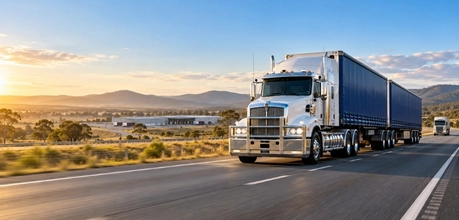
- Road freight remains the dominant mode for domestic land transport, especially for general cargo and shorter distances.
- Rail freight plays a key role in bulk transport (minerals, agricultural commodities) along established corridors.
- Air freight serves niche segments—time-sensitive, high-value, perishable goods.
According to forecasts from Freight Australia, the domestic freight task is expected to grow ~26 % between 2019–20 and 2049–50, from 765 to 964 billion tonne-kilometres, with road freight projected to grow ~77 % in activity to 2050.
However, rail’s share of non-bulk freight is relatively small, reflecting network constraints.
Let’s examine each mode in detail.
Road Transportation
Advantages
- Flexibility & door-to-door service
Road transport offers unmatched flexibility—you can pick up goods from almost any location and deliver directly to the destination without needing transfers. This is crucial for intrastate transportation or rural/regional drop zones.
- Wide network coverage
Australia’s road network extends to most reachable areas (towns, farms, regional centers), making it ideal for “last-mile” delivery where rail or air can’t reach.
- Quick routing & schedule adaptability
With roads, detours, route changes, and schedule adjustments are easier—helpful in logistical disruptions or varying demand.
- Lower fixed infrastructure requirements
Roads already exist broadly; freight operators need only maintain trucks rather than heavy rail infrastructure.
- Good for smaller, frequent loads / pallet freight
For shipments that don’t fill an entire train or need faster turnaround, road freight and pallet freight services are cost-effective.
Disadvantages
- Fuel costs, maintenance, and driver wages
For long distances, fuel, tolls, and upkeep add substantial costs. Fuel price volatility can heavily affect margins.
- Traffic congestion & delays
Road congestion, accidents, roadworks, and delays in urban areas are more common and unpredictable than in rail corridors.
- Emissions and environmental impact
Road freight is more polluting per tonne-kilometre. Rail can produce ~16× less carbon per tonne-kilometre than road.
- Limited efficiency on long hauls
Over thousands of kilometres, especially with heavy loads, road transport loses cost and energy efficiency vs rail.
- Wear on road infrastructure & regulatory constraints
Heavy trucks accelerate wear on highways; also, regulatory constraints (e.g. axle load limits, vehicle size restrictions) apply.
Rail Freight
Advantages of Rail Freight Australia
- Cost-effective for bulk and heavy loads
For large volumes over long distances, rail often delivers a lower cost per tonne than road. - High capacity & economies of scale
A single train load can replace dozens of large trucks. One estimate: a freight train can replace ~65 B-double trucks.
- Lower emissions & environmental benefits
Rail freight emits significantly less CO₂ per tonne-km. In Australia, rail produces ~16× less carbon pollution per tonne-km than road.
- Reduced congestion & safety
Fewer heavy trucks on highways can ease congestion and reduce accident risk.
- Consistency & predictability
Rail is less subject to traffic conditions; scheduled runs tend to be more reliable for long hauls.
Disadvantages
- Limited network reach / lack of ubiquity
Many regional and rural destinations aren’t served directly by rail, requiring road trucks for “first mile” / “last mile” transfers.
- Slower transit for medium/short distances
For shorter freight legs, rail may underperform due to scheduling and transfer overheads.
- Less flexibility / scheduling constraints
Trains run on fixed schedules and routes. Adjusting last-minute is harder.
- Handling transfers / multimodal cost
Additional costs arise from transferring goods to/from trucks at terminals, including handling, storage, and coordination.
- Initial infrastructure / track limitations
Infrastructure quality, track gauge differences, capacity bottlenecks, single-track sections, and speed restrictions can reduce rail effectiveness. For example, the Sydney–Melbourne rail corridor has slow segments and single-track portions, limiting speed.
Moreover, rail investments in Australia have lagged; insufficient electrification is a hurdle too.
Air Freight
Advantages
- Fastest delivery
No mode can match air freight for transit time—ideal for urgent, time-sensitive cargo (e.g. perishables, critical spare parts).
- High reliability & schedule frequency
Multiple daily flights and a robust aviation network mean more options and tighter schedules.
- Good for high-value, low-volume goods
When the value per kg is high, the premium cost of air freight is justifiable.
- Reduced handling & damage risk
Fewer transfers and handling stages lower damage or theft risk.
Disadvantages
- Very high cost
Air freight is the most expensive mode on a per-kg or per-volume basis for domestic transport.
- Weight / size / density restrictions
Only lighter, more compact and high-value goods make sense; bulky or heavy items may exceed aircraft capacity or become cost-prohibitive.
- Weather / operational dependency
Flights can be delayed or cancelled by weather, regulatory constraints, or airport congestion.
- Limited coverage to rural or remote areas
Airports exist only in certain hubs; additional road transport is required to reach final destinations.
- Higher security / regulatory protocols
Stringent rules, customs, handling regulations and paperwork add time and cost.
Cost Comparison (Road vs Rail vs Air in Australia)
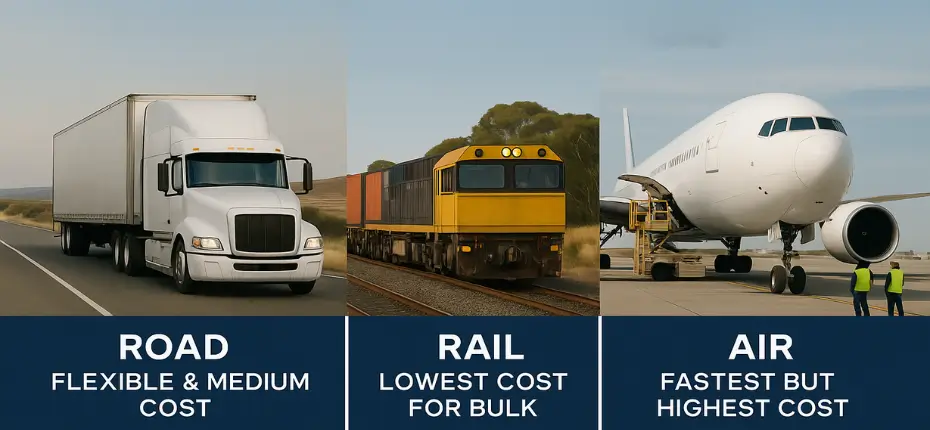
While exact rates vary widely depending on route, cargo type, weight, and service level, here is a conceptual comparison to help guide decisions:
|
Mode |
Strength in Cost |
Weakness in Cost |
Approx relative cost (for typical loads) |
|
Road |
Good for short/medium loads; lower handling cost |
Fuel, distance, driver cost, tolls |
Intermediate (cheaper than air, more expensive than rail for large loads) |
|
Rail |
Best for heavy, bulk volumes over long distance |
Terminal handling and transfer costs |
Lowest cost per tonne-km for bulk over long distance |
|
Air |
Excellent for fast, high-value cargo |
Much higher cost per kg/volume |
Highest cost among the three |
Example estimation (hypothetical):
- Road: $0.15–$0.35 AUD per kg for a 1,000 km domestic haul (depending on freight class, urgency)
- Rail: $0.10–$0.25 AUD per kg for bulk, long distance (assuming you can fill a train)
- Air: $1.20–$3.50 AUD per kg (or more) depending on volume, weight, and route
These are illustrative — actual quotes from providers like Alpha Trucking, rail operators, or air cargo carriers will vary.
Best Mode of Freight Transport Australia: Use Cases
Here’s how each mode typically fits different scenarios in Australia:
Road: Best for
- Short to medium distances (e.g. intra-state, 0–800 km)
- Flexible delivery windows
- Mixed or smaller loads / pallet freight
- Locations not served by rail or air
- Urgent but not ultra-urgent shipments
Rail: Best for
- Heavy, bulk goods (minerals, grain, coal, construction materials)
- Long distance inter-city shipments (especially along established corridors)
- When cost per tonne is critical
- Sustainable / green logistics goals
Air: Best for
- Time-critical or emergency shipments
- High-value, perishable, or specialised goods
- Small volume but high revenue cargo
- When just-in-time logistics matters
More often than not, the best solution is intermodal—using a combination. For example:
- Rail for the bulk leg (e.g. from Sydney to Adelaide), then trucks for last-mile delivery
- Air for urgent portions + road to feed into/from airports
Intermodal Solutions: Combining Modes for Efficiency
Intermodal or multimodal freight blends the strengths of different transport modes. Key benefits:
- Cost-efficiency + speed trade-off
Use rail or road for the bulk distance, air or road for urgency or final legs.
- Flexibility & redundancy
If one mode faces disruption (e.g. rail track issues or weather impact on flights), the system can adapt.
- Optimised resource use
You pay for premium transport only on parts that require it.
- Extended reach
Reach destinations not directly served by rail or air via connecting modes (road feeders).
When designing intermodal transport, you must manage transfer points, handling time, coordination, and potential delays—Alpha Trucking helps organise end-to-end solutions that integrate rail, road, air + freight forwarding services Australia to smooth transitions.
Conclusion
So, which is best? It depends. There is no single “best mode” universally — the optimal choice depends on:
- Cargo type (bulk vs high-value)
- Distance
- Urgency
- Destination location / network access
- Cost constraints
- Environmental / sustainability goals
In many practical cases, intermodal solutions (combining road + rail, or road + air) deliver the right balance of cost, speed, and flexibility.
At Alpha Trucking, we specialise in tailoring domestic freight strategies. Whether you need intrastate transportation, pallet freight, or full interstate haulage, we can advise the best mode or mix and execute with precision. Contact us today to explore the best freight plan for your business.